

7 Passport Mistakes Europeans Make When Moving to the Middle East
A guide for European expats moving to the Gulf region


My colleague had spent six months preparing her move to Dubai. The job offer was the best of her career. The apartment deposit was paid. The resignation letter was drafted. And then, two weeks before the flight, she looked at her German passport.
Six months and eleven days of validity remaining.
The UAE visa she had applied for required six months of validity beyond the visa’s duration. A two-year employment visa. That meant the passport needed to be valid for well over two years from the date of entry. She was short, not by months, but the maths simply didn’t work.
The German consulate in Dubai had an appointment backlog of eight weeks. Renewing from Germany would take two to three weeks if everything went smoothly. The onboarding date was fixed. The employer had already started the visa sponsorship process for her and her family.
My colleague made it. But only through a combination of emergency consular appointments, an express courier service between Frankfurt and Dubai, a very patient HR manager, and about €700 they had not budgeted for. The start date shifted by three weeks. Three weeks of unpaid limbo in a city they had not yet officially moved to.
"I had checked everything. Flights, shipping, lease, visa. The passport was just sitting there. I assumed valid meant valid."
It is the most common and most preventable passport crisis I see Europeans face when relocating to the Gulf. And it is one of seven mistakes that quietly derail otherwise carefully planned moves.
Most Europeans discover Gulf passport rules the same way, in a panic, two weeks before they fly.
The 7 Mistakes
Mistake #1: Ignoring the “validity beyond entry” rule
This is my colleague’s mistake, and it catches Europeans repeatedly because it runs counter to how passports work everywhere else. In the EU, a valid passport means a passport that has not expired. In the Gulf, it means something different.
The UAE, Qatar, Saudi Arabia, Bahrain and Kuwait all require your passport to remain valid for six months beyond your intended stay, not merely your arrival date. For a two-year employment visa in Dubai, that means your passport must be valid for two years and six months from the day you land. For a three-year visa, nearly four years from entry.
Most German, French and Dutch passports are issued for ten years. If you applied at 28 and you’re moving at 35, your passport might have three years left. Enough for a tourist, not enough for a working resident.
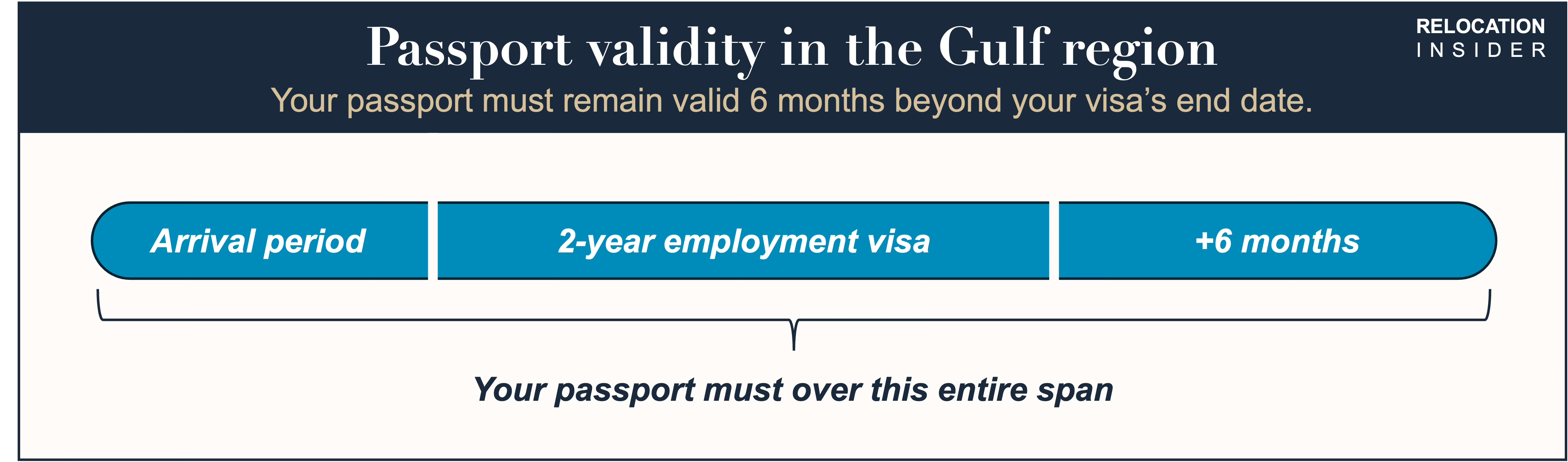
Relocation Insider tip: Check: arrival date + full visa duration + 6 months. If your passport expires anywhere in that window, renew before you apply. Not after.
Mistake #2: Assuming a European passport renews quickly from abroad
Renewing a German or British passport in their home country is reasonably fast. Two to four weeks at your local citizen's office, depending on demand. Renewing it once you are already living in Dubai is a fundamentally different process.
The German consulate in Dubai operates with limited appointment slots and high demand from a large German expat community. Processing times typically run eight to twelve weeks. The same is true for French, Dutch, Belgian and Spanish passport holders. Most EU embassies in the Gulf are staffed for diplomatic functions first, and administrative services second.
Europeans who discover this mid-residency, when their passport is already close to expiry, face a genuine crisis. You cannot leave the UAE on an expired passport. You cannot renew your residency visa without a valid passport. The two problems compound each other.
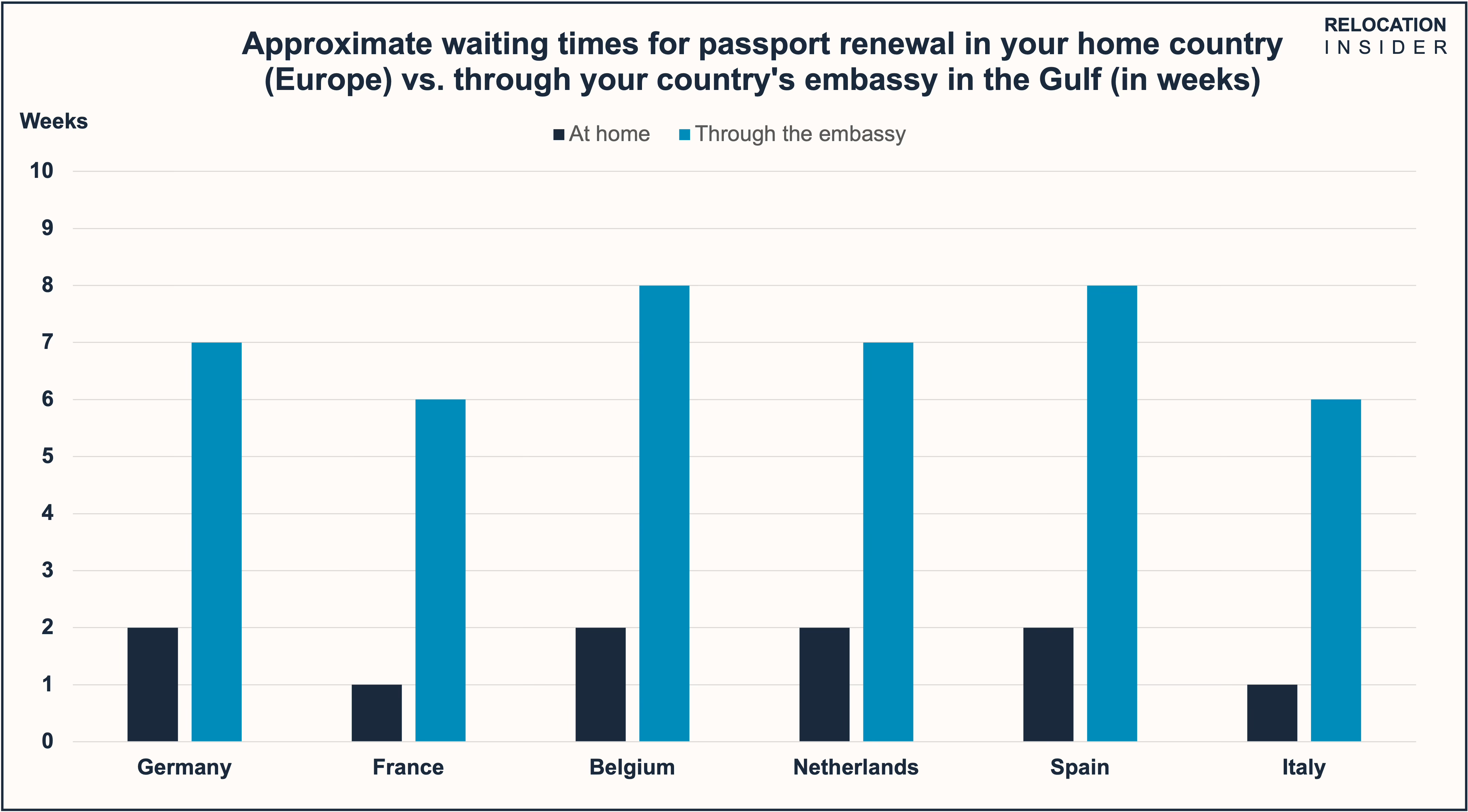
Relocation Insider tip: Processing times through Gulf embassies are typically 3–4× longer than renewing at home. Plan around this, not after. If your passport expires within 18 months of your planned move date, renew it before you leave your home country. Do not wait until you are settled.
Mistake #3: Running out of blank pages mid-residency
A standard German or EU passport has 32 pages. It fills faster in the Gulf than most Europeans expect. Your UAE residency visa takes a full page. A re-entry visa takes another. Entry and exit stamps accumulate every time you travel, and Europeans living in Dubai travel frequently: weekend trips to Oman, family visits back to Germany, conferences, holidays across the region.
Two years into a Dubai residency, it is entirely common to have fewer than four blank pages remaining. Most Gulf countries require at least two consecutive blank pages for entry. If you arrive at Dubai International with a full passport, you will not be admitted, even if you live there:
Relocation Insider tip: Count your blank pages before every international trip, not just before the move. Apply for a 48-page passport at renewal, most EU countries offer this at no extra cost. Your Gulf residency visa (e.g., for UAE, Oman, Qatar, Saudi Arabia) alone consumes one full page; account for this from the start.
Mistake #4: Confusing visa-free access with the right to work
German passport holders can enter the UAE without a prior visa for tourist stays of up to 90 days. This is a genuine privilege and a useful one. The mistake is assuming it extends further than it does.
Entering the UAE on a tourist arrival and then beginning work, even one day of work, even remote work for a European employer, before your employment visa and work permit are formally approved and stamped is a legal violation. It can result in deportation, a ban on re-entry, and serious complications for your employer’s sponsorship licence.
The pressure to start early is real. Employers push for it. The logic feels harmless: you are already here, the visa is coming, why wait? But the UAE’s labour and immigration authorities do not treat informality the same way European HR departments do.
Relocation Insider tip: Never start work until your residence visa and labour card are physically in your passport and activated. Not when they are "in process." Not when HR says it's fine. When they are stamped and valid.
Mistake #5: Not sorting your home country’s registration before you leave
Germany requires residents moving abroad to formally deregister at your local citizen office. Several other EU countries with mandatory population registers, including the Netherlands, Belgium and Austria, have equivalent processes. Many Europeans skip this step, maintaining a ghost registration at a parent’s or sibling’s address back home. The reasoning is practical: it keeps German banking, statutory health insurance and administrative access intact.
The problem surfaces when you need to renew your passport through your consulate in Dubai. The consulate will ask for proof of registered residence. If your official address is still in Munich but you have been living in Dubai for two years, the documentation doesn’t align and consular staff are not there to help you untangle it.
The cleaner path is to handle registration deliberately before you leave: complete the Abmeldung, understand what you are giving up by doing so, and confirm exactly what your consulate in Dubai will require when you eventually need to renew. Neither staying registered nor deregistering is inherently wrong. What creates the problem is arriving at a consulate appointment having done neither intentionally.
Relocation Insider tip: Decide before you leave. Deregister fully, or maintain formal home country registration intentionally. If deregistering, complete the Abmeldung before your departure date. Understand which documentation your consulate requires for passport renewal in the Gulf.
Mistake #6: Letting the passport become a last-minute problem during visa renewal
UAE residency visas are typically issued for two or three years and must be renewed. When renewal time comes, your passport must again meet the validity requirements, at least six months beyond the new visa’s end date. If your passport is approaching expiry at the same time your residency visa needs renewing, both processes collide.
You cannot renew your UAE residency visa on a passport that is about to expire. You must renew the passport first, then update your residency, which means your Emirates ID, your bank records, your tenancy agreement and every other document tied to your passport number also need updating. Europeans who let this situation develop often spend two to three months in administrative limbo.
Relocation Insider tip: Set a calendar reminder 18 months before your passport expires. At that point, begin the renewal process, regardless of what else is happening with your residency or visa cycle.
Mistake #7: Treating the passport as an afterthought in the relocation plan
This is the mistake that makes all the others possible. Every European who relocates to Dubai has a checklist. Employment contract, visa sponsorship, accommodation, shipping, school applications, bank account. The passport is present on none of them because it is assumed, not planned.
My colleague’s situation was not the result of carelessness. They are thorough and organised. The passport simply was not on their radar as something requiring detailed scrutiny. It had worked perfectly for seven years of European travel. It had never been a problem before. There was no reason to look closely at it.
But moving to the Gulf is not the same as travelling within Europe. You are entering a multi-year legal relationship with a country where your passport is not just a travel document — it is the foundation of your residency, your employment, your banking, your ability to leave and return. It needs to be treated accordingly.
Relocation Insider tip: Do the 15-minute check! Expiry date. Blank pages. Embassy renewal timeline from your destination town (e.g., Muscat, Dubai, Abu Dhabi, Doha, Riyadh). Home country deregistration status. Visa category for your actual activity. Do it now, before any visa application begins.
The framework: before you apply for anything
My colleague’s story ends well. She and her family are now in Dubai, settled, and doing the job they came for. They have also renewed their passport with a 48-page document and eleven blank pages to spare. But they did it under pressure, at cost, and with a delayed start that complicated their first month in the city.
The framework they now use is simple. Run it before you apply for any visa in the Gulf, before you accept a start date, and before you book a flight.
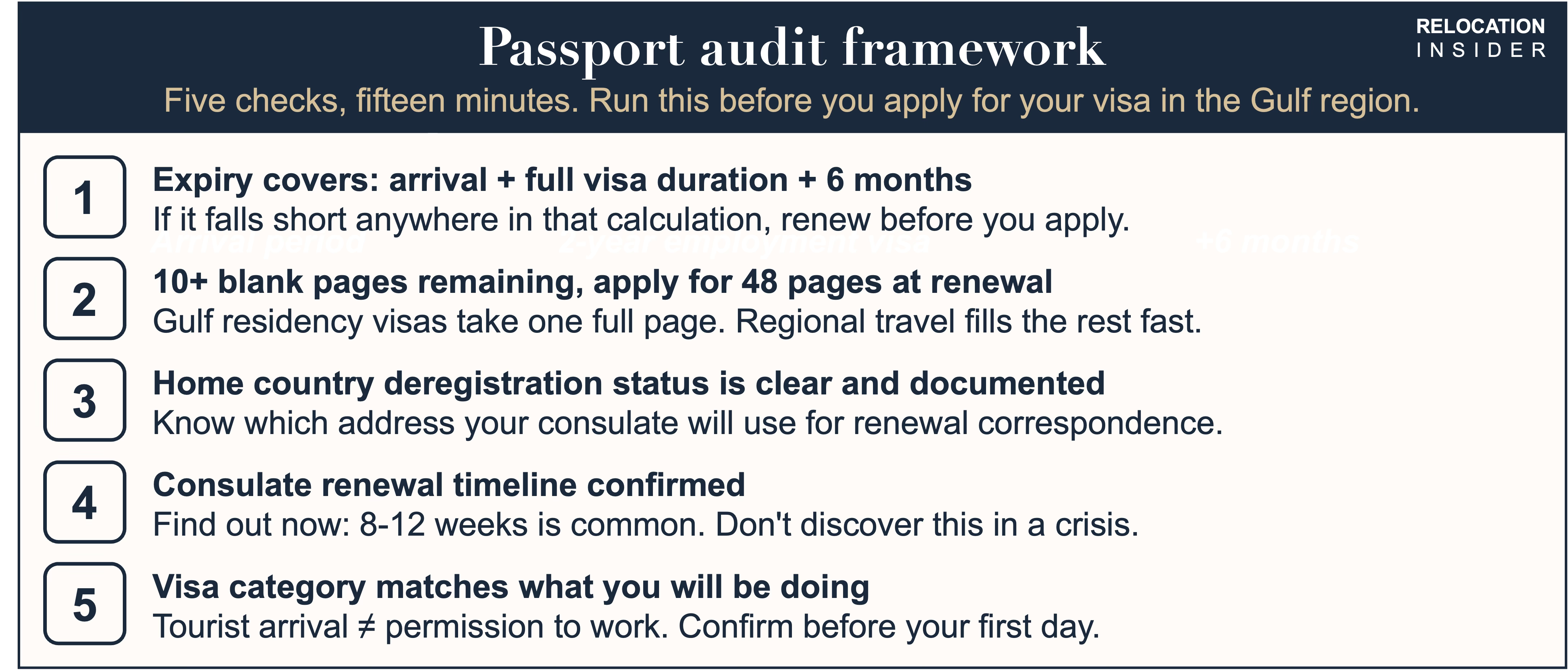
None of this is complicated. All of it is easy to overlook when you are also coordinating a shipping container, negotiating a lease in a city you have never lived in, and managing a handover at your current job. That is precisely why it needs to be a deliberate checklist, done early, not a glance at the document two weeks before you fly.