

A Union on the Move: EU Citizens Living Outside Their Home Country
Free movement is one of the European Union's founding promises


Free movement is one of the European Union’s founding promises. Roughly 14 million Europeans have taken it up but the burden and the benefit of mobility are spread very unevenly across the 27 member states.
Every citizen of an EU member state holds, alongside their national passport, a second legal identity: citizenship of the Union. With it comes the right to live, work and study in any of the 27 member states without a visa or work permit. It is one of the most tangible things the EU does for ordinary people and the statistics show how extensively, and how unevenly, Europeans use it.
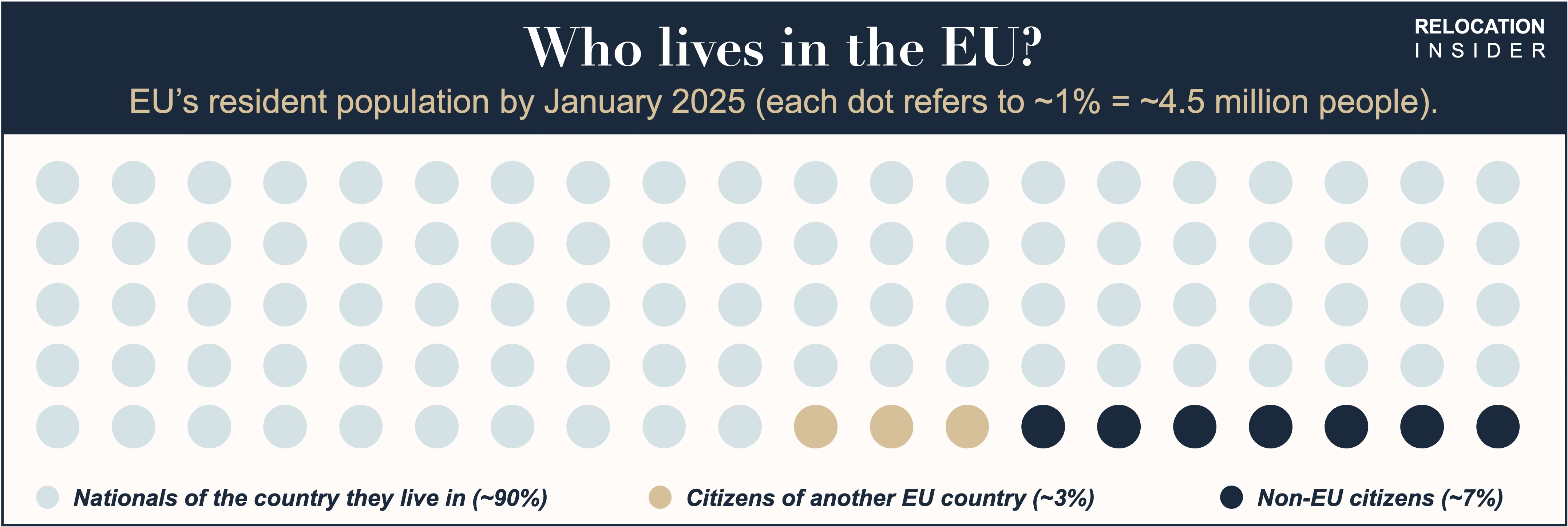
According to Eurostat, on 1 January 2025 an estimated 14.1 million people were living in an EU country while holding the citizenship of another EU country, about 100,000 more than a year earlier. That is roughly 3.1% of the Union’s 450.6 million residents. For comparison, 30.6 million residents (6.8%) were citizens of non-EU countries, meaning that of the roughly 45 million “non-nationals” in the EU, about one in three is a fellow European exercising free movement.
Romania leads by a wide margin
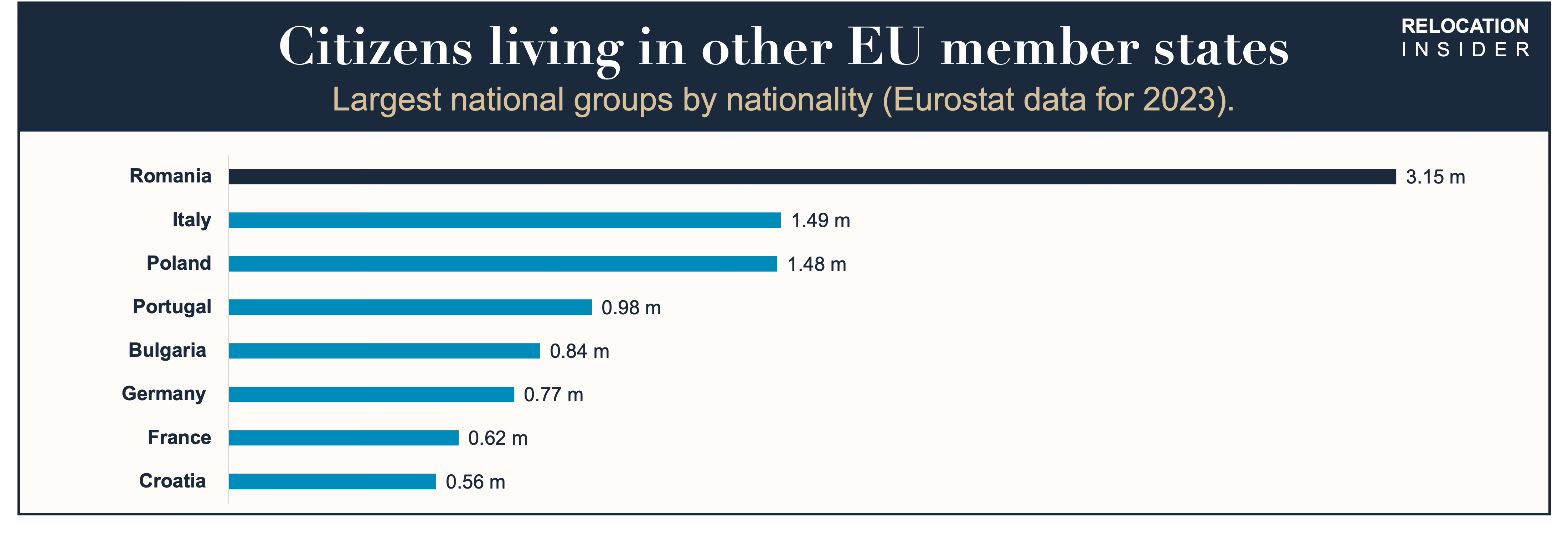
No nationality has embraced intra-EU mobility on the scale of Romanians. Around 3 million Romanian citizens live in other member states, more than one in five of all mobile EU citizens. Since Romania joined the Union in 2007, millions have moved to wealthier economies, above all Italy, Spain and Germany, in search of higher wages.
Italy and Poland follow, each with roughly 1.5 million citizens living elsewhere in the EU, and Portugal comes next with about 1 million. The Polish and Portuguese stories echo the Romanian one: accession (Poland in 2004) or a long tradition of labour emigration (Portugal) pushed large communities toward Germany, France, the Netherlands and beyond. Italy is a special case, its diaspora combines older post-war labour migration to Germany and Belgium with a newer wave of young graduates who left after the eurozone crisis.
Small countries, big diasporas
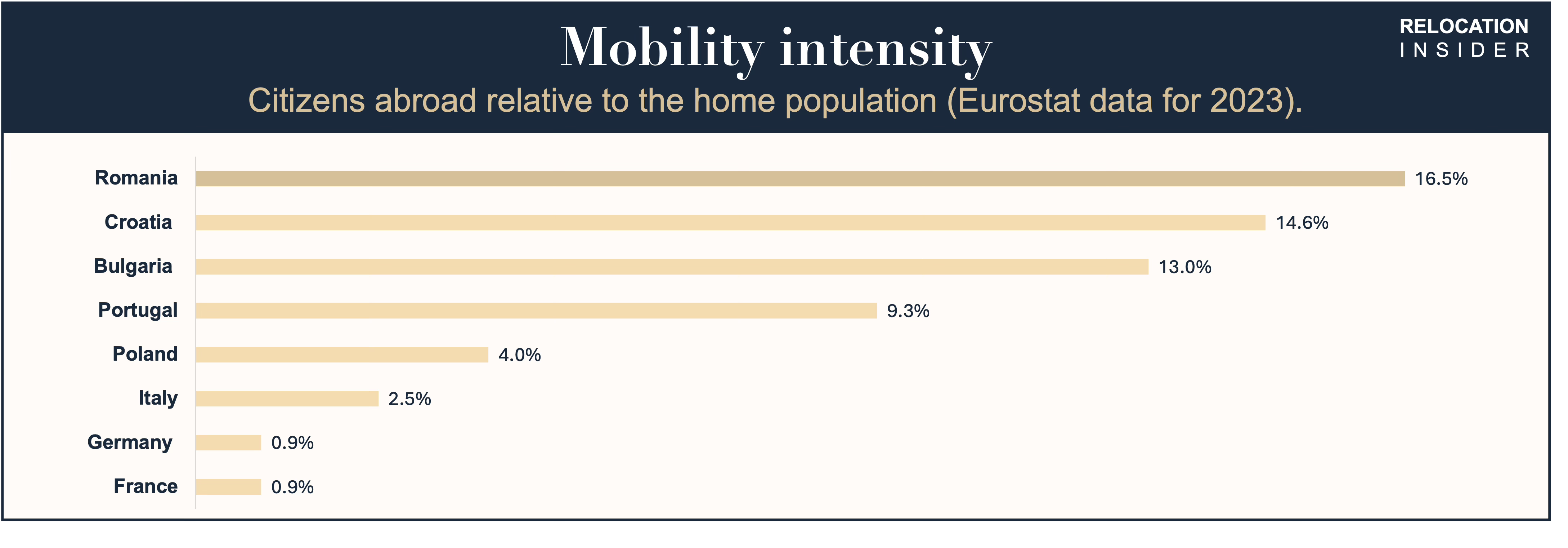
Absolute numbers flatter the big member states and hide the true intensity of emigration. Germany and France each have over 600,000 citizens living elsewhere in the EU, but against domestic populations of 84 and 68 million respectively, that is less than 1% of their people. The picture is dramatically different in Central, Eastern and Southern Europe.
Relative to the population still living at home, Romania, Croatia and Bulgaria stand out: their citizens living elsewhere in the EU are equivalent to roughly 13–17% of the resident population. Croatia’s figure is striking given that it only joined the Union in 2013, more than half a million Croatians, from a home population under four million, now live in other member states. Eurostat’s labour-mobility research found the same pattern years ago: already in 2017, working-age Romanians abroad amounted to nearly 20% of Romania’s working-age population, against about 1% for Germans.
Where do they go? Luxembourg is the outlier
On the receiving end, mobile Europeans concentrate in a handful of destinations. Germany, Spain, France and Italy host the largest absolute numbers of non-nationals of any kind, together, some 70% of all foreigners in the EU. But proportionally, nowhere compares to Luxembourg, where citizens of other EU countries, chiefly Portuguese, French, Italian and Belgian nationals, make up about 36% of the entire population. Cyprus and Austria follow at around 10% each. At the other extreme, other-EU citizens are a rarity in Poland, Romania and Slovakia, which remain overwhelmingly countries of origin rather than destination.
The tide is turning (for some)
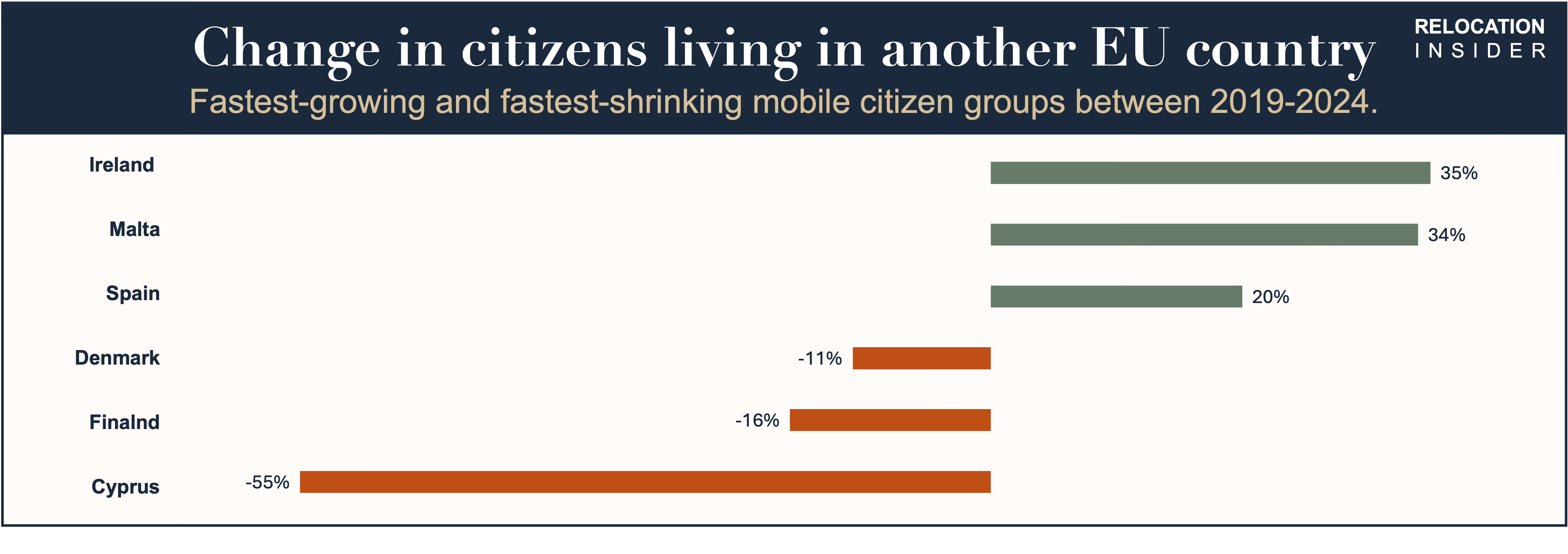
Intra-EU mobility grew strongly through the 2000s and 2010s, but it has now broadly plateaued: the stock of mobile EU citizens rose by only about 0.1 million in the year to January 2025, while the number of non-EU citizens grew by 1.6 million. Beneath the flat total, national trajectories diverge sharply. Between 2019 and 2024 the number of Irish (+35%), Maltese (+34%) and Spanish (+20%) citizens living elsewhere in the EU grew fastest, while the number of mobile Cypriots collapsed by 55%, and Finnish (−16%) and Danish (−11%) citizens abroad also declined, a sign that for some wealthier or recovering economies, mobility now flows both ways, including back home.
Focus on Germany: Europe’s magnet, modest sender
Germany embodies the asymmetry of European mobility. As a destination, it is in a league of its own: on 1 January 2025 it hosted 12.4 million non-nationals, more than any other member state, and 17.2 million foreign-born residents, about one fifth of its population. Millions of the EU’s mobile citizens, above all Poles, Romanians, Italians, Bulgarians and Croatians, have made Germany their home, and in 2023 it also received the largest number of new arrivals from other EU countries (around 334,000, or 22% of all intra-EU immigration).
As a sender, however, Germany is remarkably immobile. Only about 774,000 German citizens live in other EU member states under 1% of its 84 million people, the lowest mobility rate of any large member state alongside France. Those who do leave head mostly to Austria (helped by a shared language), Spain and the Netherlands, with retirees favouring the southern coasts. The result is a structural imbalance: for roughly every German living elsewhere in the EU, more than five other-EU citizens live in Germany.
And the United Kingdom? A special case since Brexit
The UK left the EU on 31 January 2020, so British citizens no longer appear in Eurostat’s intra-EU mobility figures but the UK remains the most important “27+1” mobility story in Europe. Before the 2016 referendum, an estimated 900,000 to 1.2 million British citizens lived in other EU countries, concentrated in Spain (~309,000), Ireland (~255,000), France (~185,000) and Germany (~103,000). Those already resident before January 2021 kept their rights under the Withdrawal Agreement, and naturalisations of Britons across continental Europe have since surged by more than 600% as UK nationals sought to lock in EU citizenship.
The flow in the other direction was far larger. At the 2021 census, 5.3 million people in the UK held an EU passport (about 4 million residents were EU-born), led by more than a million Poles, over 700,000 Romanians and over 400,000 Irish citizens. More than 6 million EU nationals have secured status under the post-Brexit EU Settlement Scheme. Since free movement ended, however, the tide has reversed: net migration of EU citizens to the UK has been negative every year since 2022, around 70,000 more EU nationals left than arrived in the year to mid-2025, and the EU population of the UK has shrunk by an estimated 162,000 since 2021. Meanwhile over 60,000 EU citizens took British citizenship in 2024 alone, three times the pre-referendum rate, mirroring, in reverse, what British residents of the EU have done.
Relocation Insider’s take from it
Behind the statistics sits a classic push–pull dynamic: wage gaps, job opportunities and family networks pull people toward Germany, Spain and the Benelux countries, while limited prospects at home push them out of the EU’s east and south. Mobile EU citizens tend to be of working age and increasingly highly educated, the share of tertiary graduates among them rose from about 24% to 32% in a single decade, which makes mobility a boon for host-country labour markets but raises fears of “brain drain” and demographic decline in origin countries. Romania, Bulgaria and Croatia, the three most mobility-intensive nations, are also among the EU countries with the fastest-shrinking populations.
Yet the same data also show free movement working as designed. Fourteen million people have built lives in another member state, return migration is rising in several countries as economies converge, and in places like Luxembourg, a genuinely pan-European society already exists. The number of EU citizens living outside their home country is, in the end, a live measure of how real European integration is, not in treaties, but in people’s lives.