

Climate Risk is Changing Where Europeans Move
Europe is warming twice as fast as the global average


From flooded Greek villages to overheating Mediterranean coasts, the continent’s movers are starting to read risk maps before property listings and insurers are pushing them along.
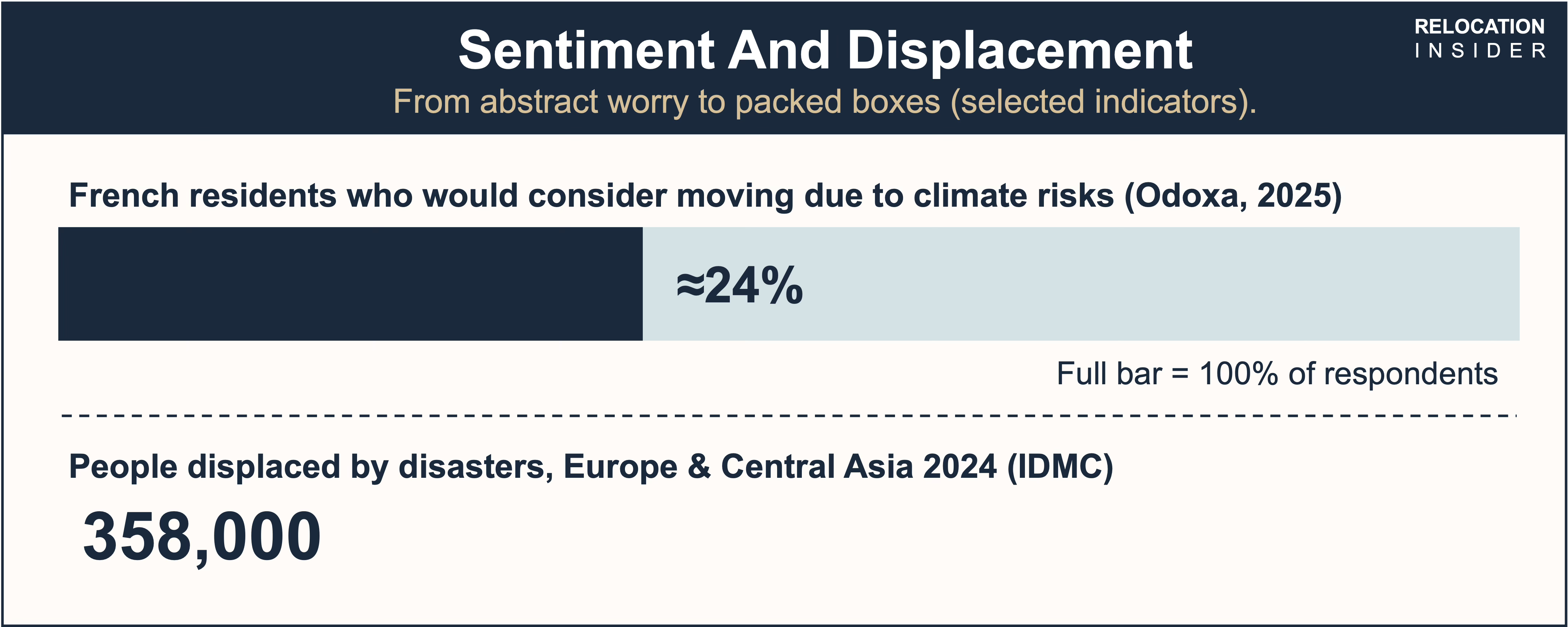
When Storm Daniel drowned the plains of Thessaly in September 2023, one Greek family watched on holiday as their neighbours climbed onto rooftops back home. Their house was left uninhabitable. More than two years later, they still haven’t returned. In the nearby village of Metamorphosis, residents went further. They held a referendum and voted overwhelmingly to relocate the entire village. Across Europe, stories like these are no longer outliers. The Internal Displacement Monitoring Centre counted roughly 358,000 people displaced by disasters across Europe and Central Asia in 2024 alone, most of them driven by weather-related hazards.
The headline numbers explain why. Europe has warmed about twice as fast as the global average since 1980. Between 1980 and 2023, extreme weather killed around 240,000 people on the continent and caused roughly €738 billion in economic losses and the curve is bending upward, not down. Annual climate-related losses have climbed from about €8.5 billion per year in the 1980s to more than €40 billion per year in the 2020s, with each of the past four years ranking among the five costliest on record.
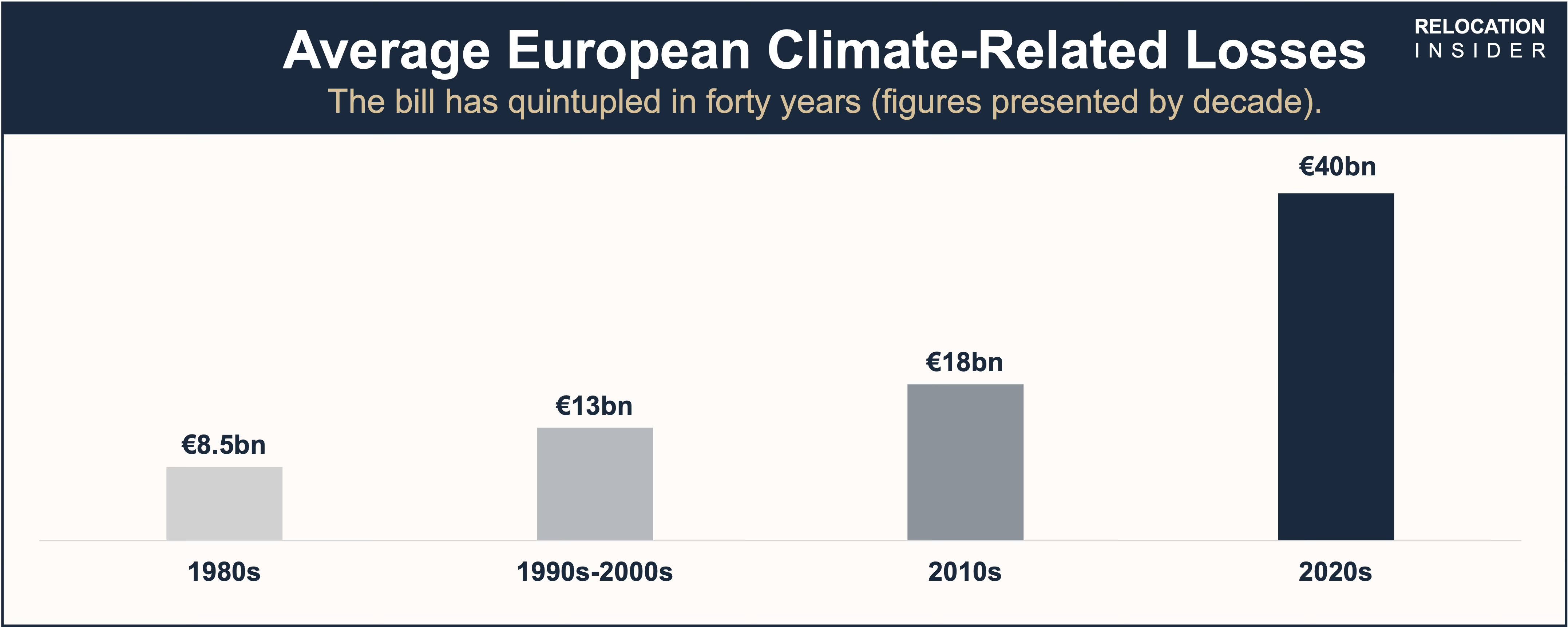
The quiet migration has started
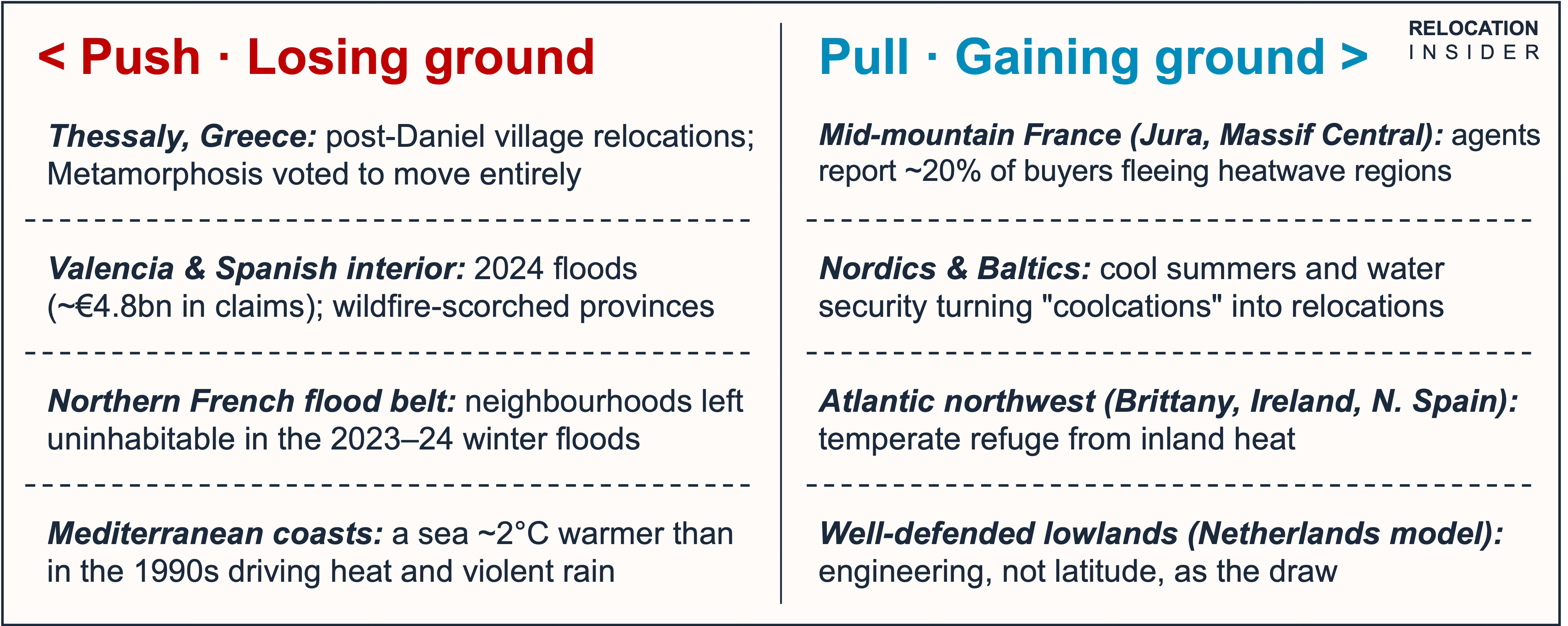
Unlike a hurricane evacuation, European climate migration rarely announces itself. It shows up as a family from flooded Thessaly resettling in Arta, as households in northern France declining to return after the 2023–24 winter floods left entire neighbourhoods uninhabitable, or as retirees quietly trading a heat-stressed region for the hills. In France, which topped the region for climate-related internal displacement in 2022, with 45,000 people forced from their homes, an estate agent in the Jura mountains reports that about one in five of her recent clients is leaving a heatwave-exposed region for the cooler mountain climate.
Researchers who spent years telling Europeans that climate migration was something that happened elsewhere say the perception has flipped. The EU-funded HABITABLE project, the largest European research effort on climate and migration to date, found that many Europeans now see climate-driven relocation as a problem they themselves could face, not just a distant-continent phenomenon.
Part of the French and European population is already moving, and will continue to move, for environmental reasons, and we still underestimate it.— FRANÇOIS GEMENNE, CLIMATE-MIGRATION RESEARCHER AND IPCC AUTHOR (PARAPHRASED)
Insurance is doing the pushing
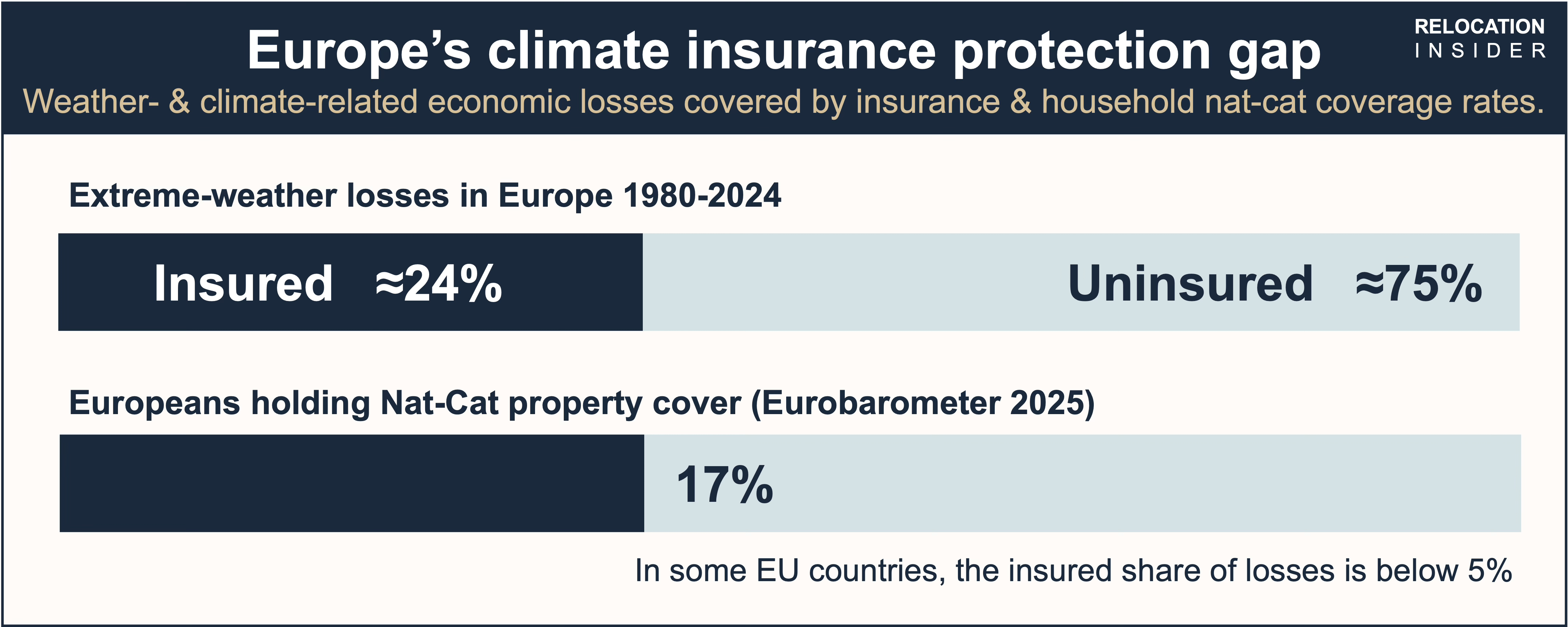
If American climate migration is driven by insurance bills, Europe’s version is driven by their absence. The continent has a vast protection gap: only about a quarter of losses from extreme weather between 1980 and 2024 were insured, and in some countries the insured share is below 5%. EIOPA’s 2025 Eurobarometer found that just 17% of Europeans hold cover for natural-catastrophe damage to their property. When disaster strikes, most households absorb the loss themselves and an uninsured, unsellable home is one of the strongest push factors there is.
The squeeze is coming from both directions. The German insurance association has warned that property premiums could double within a decade because of climate-driven claims, and in the highest-risk zones insurers are beginning to withdraw or write in exclusions, the same dynamic that made parts of California effectively uninsurable. Meanwhile, Germany still adds an estimated 1,000–2,400 new buildings to high-risk flood zones every year. Spain’s Valencia floods of October 2024 showed what the alternative looks like: because the country’s public Consorcio scheme automatically extends catastrophe cover to nearly every policy, nine in ten affected buildings were insured, generating over 250,000 claims worth around €4.8 billion, painful, but recoverable. Where such schemes don’t exist, recovery often means leaving.
Where the movers are going
Europe’s emerging climate geography follows the thermometer. The Mediterranean Sea is roughly 2°C warmer than three decades ago, supercharging both drought and the violent rainfall that flooded Valencia; Portugal has touched 48°C. The push is southern and coastal, scorched interiors of Spain and Greece, flood-prone river plains, eroding Atlantic and North Sea shorelines. The pull is northern and upland: the French Jura and other mid-mountain regions, the Atlantic northwest, the Nordics and Baltics, whose “coolcation” tourism boom is increasingly previewing permanent moves. None of these places is risk-free. Slovenia’s 2023 floods and Germany’s 2021 Ahr valley disaster proved the north floods too but relative risk is what redirects movers, and it now points north.
Policy is scrambling to catch up. The EU’s new Pact on Migration and Asylum, in force since June 2026, has been criticised for barely addressing climate-driven movement at all. Meanwhile the EU Floods Directive already lists relocation among legitimate flood-management tools, and preventive relocations are being studied from Portugal to Austria to Wales. The ECB and EIOPA have proposed an EU-wide public-private reinsurance scheme that modelling suggests could shrink the protection gap from 75% to around 10% at the price of up to €65 billion in public backstop capacity. Whether Europeans move, stay, or get stranded will depend heavily on which of these frameworks materialise.
Who gets to move and who doesn’t
The hard edge of this story is the same in Europe as everywhere: mobility takes money. Migration researchers consistently find that the households facing the gravest risk are often the ones least able to leave, the “trapped populations” without savings, portable work, or a network at the destination. In the divided Greek village of Vlochos, the argument between those demanding relocation and those refusing to abandon three generations of home has, at times, turned physical. Climate migration in Europe is not only a market trend for Relocation Insider readers to track; it is becoming one of the continent’s defining social questions.
What this means for your move
If you’re relocating within Europe or buying that long-dreamed-of second home climate risk now belongs on the checklist next to schools, taxes and transport links.
Five practical steps:
1. Check risk at the address, not the country
Use national flood maps (e.g. France’s Géorisques, the UK’s flood-risk service, Germany’s state Hochwasser portals) and the EEA’s European climate-risk resources. River valleys flood in “safe” countries too.
2. Understand local insurance systems before you buy
France’s CatNat and Spain’s Consorcio bundle catastrophe cover automatically; many other countries leave it optional and most Europeans go without. Ask exactly what a standard policy excludes.
3. Get a premium quote and an insurability opinion early
With premiums in some markets projected to double within a decade, carrying costs (and future resale) can hinge on whether a property stays insurable.
4. Stress-test for heat, not just water
Summer habitability is becoming a valuation factor in southern Europe. Check cooling infrastructure, building orientation, and local heatwave records before committing.
5. Think resale, not just residence
European buyers and institutional investors are already repricing exposed assets toward resilient locations. A home that’s hard to insure today may be hard to sell tomorrow.
Sage advice. Couldn't agree more.