

Europe's Most Inconvenient Migration Story
It is not who is coming in that should worry Europe, it is who is walking out


Europe’s own citizens are leaving in record numbers and the economic fallout is only beginning to be counted.
For decades, the dominant narrative of migration in Europe focused on people arriving: refugees crossing the Mediterranean, workers from Eastern Europe filling Western labour markets, professionals drawn by the promise of stable institutions.
That story has not ended.
But it has acquired a disquieting subplot: the people already inside the European heartland are quietly packing their bags. Britons, Germans, French, Dutch, and Scandinavians are leaving their home countries in numbers that are beginning to alarm economists, pension actuaries, and policy-makers alike. The destinations vary, from the Gulf to Southeast Asia to Southern Europe’s sunbelt, but the motivations converge around a familiar constellation: high taxation, eroding purchasing power, regulatory fatigue, and a deepening sense that the European model no longer delivers what it once promised.
This is not an abstract trend. It is measurable, accelerating, and economically consequential, both for the countries being left behind and for those being chosen as replacements.
Who is leaving and why
The exodus is not uniform. It plays out across three distinct demographic streams, each with its own geography of departure and arrival.
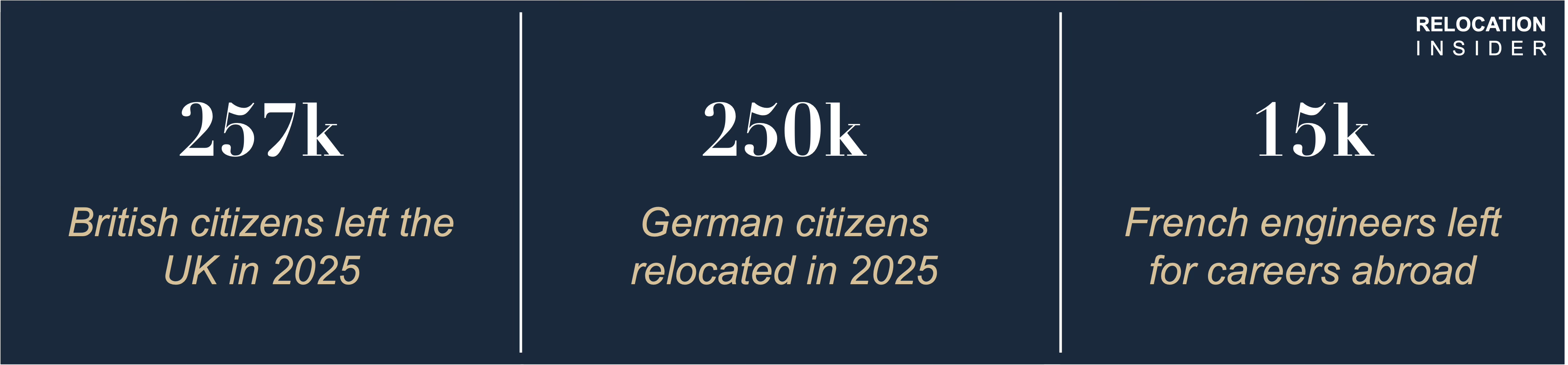
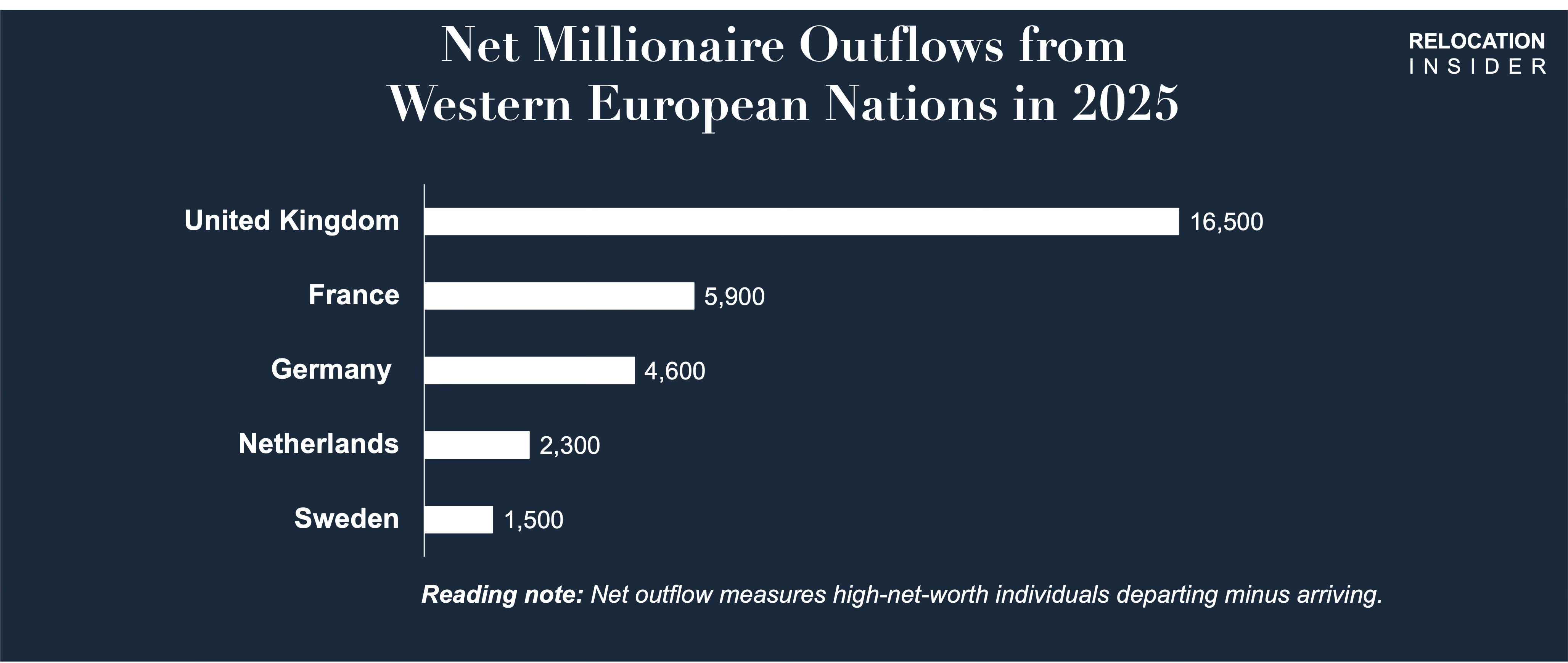
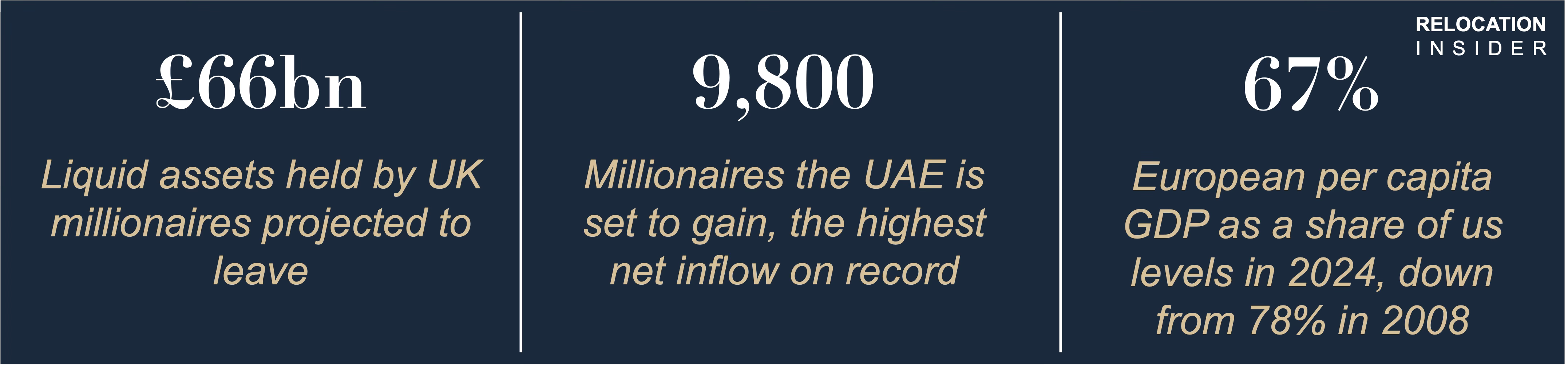
The first and most financially visible group is wealthy migrants: high-net-worth individuals who are increasingly mobile and acutely sensitive to fiscal policy. The United Kingdom has emerged as a cautionary tale in this new era of wealth migration. The country is projected to see a net loss of 16,500 high-net-worth individuals in 2025, collectively holding an estimated £66 billion in liquid investable assets, equivalent to approximately $92 billion. This follows an already record-breaking 2024, when 10,800 affluent residents departed. The triggers are explicit: in March 2024, the Conservative government overhauled the non-domicile tax regime, and Labour’s announcement of changes to inheritance tax rules in October triggered a sharp escalation. The consequences are equally concrete. When 16,500 wealthy taxpayers leave in a single year, they take not only their income tax contributions but their investment capital, their charitable giving, and their spending on local professional services.
The second stream is skilled professionals: the knowledge workers, engineers, doctors, and entrepreneurs who represent the most economically productive cohort of any workforce. Pick any year over the past decade, and you will see that around a quarter of a million German citizens moved abroad. Figures compiled by the OECD show that for every 100,000 Germans, 170 left the country in 2021, five times the rate of the USA and ten times that of Japan. In France, the numbers are equally stark. Every year, nearly 15,000 young graduates from French engineering and management schools choose to start their careers abroad. The main drivers are low net salaries due to high taxes and a perception of national decline, with 70 per cent of talented individuals surveyed believing that France is in decline, and 81 per cent expressing concern about the political situation.
The third stream, numerically the largest but analytically the most diffuse, is ordinary middle-class families and remote workers drawn abroad by cost of living, climate, and quality of life. A poll carried out for the British Council found that nearly three-quarters (72 per cent) of UK-based 18- to 30-year-olds would consider living and working abroad, primarily citing better job opportunities and quality of life. This cohort is harder to track but represents the long-term demographic base from which the other streams are drawn.
Where are Europeans relocating to?
The destinations for departing Westerners fall into two broad categories: tax-advantaged financial hubs and quality-of-life havens. These categories occasionally overlap, as in the case of Dubai or Lisbon, but the motivations they appeal to are meaningfully distinct.
The Gulf: Zero tax and the new prestige address
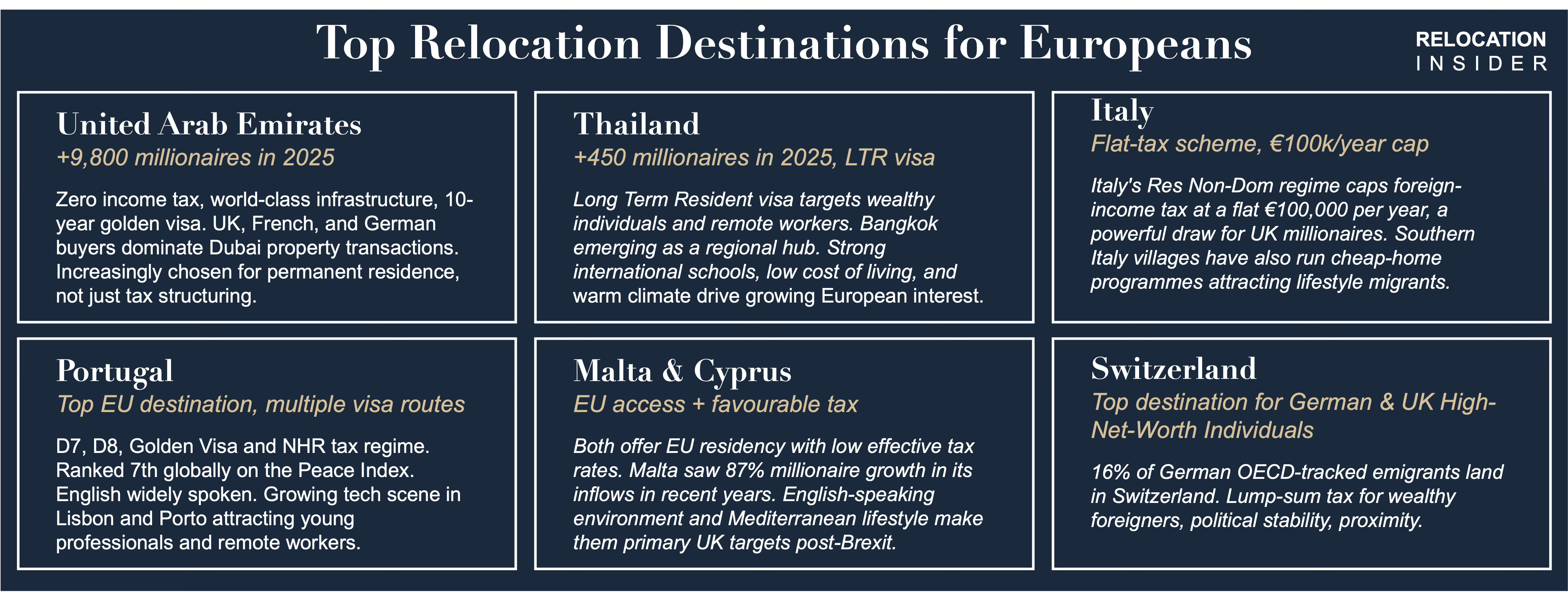
The United Arab Emirates stands as the crown jewel of modern wealth attraction, welcoming an impressive 9,800 millionaires in 2025. Dubai and Abu Dhabi have crafted a policy masterpiece: zero income tax, cutting-edge infrastructure, and seamless residency programmes that make relocation effortless. For British and French entrepreneurs in particular, Dubai has evolved from an expat posting to a permanent home. A “second wave” of wealthy Europeans, especially from the UK due to political unpredictability and concern about tax rises, has been identified by leading private bankers in the region. In the first half of 2024, the number of property buyers in Dubai from France and the UK rose 42 per cent and 18 per cent respectively.
Southern Europe: Tax perks with lifestyle
Wealthy Britons primarily relocated to EU members, specifically Italy, Malta, Switzerland, Portugal, and Cyprus, followed by the United States, United Arab Emirates, and Australasia. Portugal has been particularly adept at capitalising on Northern European mobility. Its non-habitual resident (NHR) tax regime, golden visa programme, and digital nomad visa have created a layered offer that appeals to retirees, remote workers, and entrepreneurs simultaneously. Portugal ranked as the seventh safest country in the world in the 2024 Global Peace Index, and offers high-quality healthcare and education at a fraction of the cost compared to many other countries.
Southeast Asia: The rising alternative in the sun
Beyond Europe’s own periphery, Southeast Asia has emerged as a serious alternative for younger Western professionals. Thailand is rapidly emerging as Southeast Asia’s new safe haven, with Bangkok positioning itself as a key rival to Singapore, increasingly favoured by high-net-worth individuals drawn by international schools, a growing financial services sector, and high-end real estate offerings. Thailand’s Long Term Resident (LTR) visa, launched in 2022, specifically targets wealthy individuals and remote workers and has drawn thousands of European applicants. Malaysia’s MM2H (Malaysia My Second Home) programme has similarly attracted significant numbers from the UK, Germany, and Scandinavia.
The economic consequences and what is left behind
The departure of skilled and wealthy citizens creates a complex web of economic consequences for the countries they leave. The most immediate is the loss of direct tax revenue. When a French engineer earning €120,000 annually relocates to Dubai, France loses not only income tax but social security contributions, VAT from consumption, and wealth tax where applicable. In France, with a tax pressure of 45.4 per cent, the cumulative effect of losing high earners is compounded by the sheer width of the tax base that disappears with them. Europe’s per capita income has lost more than 40 per cent of its purchasing power relative to the United States since 2000; by 2024, European per capita GDP stood at just 67 per cent of the US level, down from 78 per cent in 2008.
Beyond direct tax loss lies the more damaging long-term effect: the erosion of human capital.
Europe continues to see an exodus of researchers, engineers, medical professionals and entrepreneurs to the United States, Canada, the United Kingdom and increasingly Asia. In some cases, the EU not only trains this talent but subsidises it with taxpayer money, only to see the benefits accrue elsewhere. The UK’s National Health Service offers a particularly painful illustration: official figures showed that more than 4,000 doctors left the UK to practise abroad in a single year, even as the NHS faces chronic staffing shortages.
The pension implications are equally sobering. Western Europe’s pension systems were built on the assumption of expanding working-age populations, each generation larger than the last, collectively supporting a growing cohort of retirees. Sustained emigration of working-age, high-earning citizens undermines this arithmetic. Germany, which already faces one of Europe’s most acute demographic shortfalls, cannot afford to haemorrhage a quarter of a million citizens annually and simultaneously manage rising pension obligations.
There is also the innovation cost. There are more French founders of unicorn companies, those valued at over $1 billion, in the United States (46) than in France itself (around 22 as of 2024). Every unicorn that is built in California rather than Île-de-France represents employment, investment, and intellectual property that accrues elsewhere. Multiply this across Germany, the UK, the Netherlands, and Sweden, and the aggregate innovation deficit becomes a genuine structural threat to European competitiveness.
What destination countries gain and lose
For the countries receiving Western European migrants, the economic consequences are largely positive, at least in the short to medium term, though they come with their own complications.
The UAE’s trajectory is instructive. The influx of European entrepreneurs and high earners has accelerated the diversification of an economy once almost entirely dependent on hydrocarbons. Dubai’s prime residential market is forecast to grow by 8 to 12 per cent in 2025, outperforming most other global luxury hubs for the third consecutive year, driven in significant part by wealth migration. Western professionals bring with them networks, capital, and expertise in sectors including fintech, consulting, media, and fashion, that the UAE has been actively seeking to develop beyond its traditional strengths.
Portugal’s experience is more nuanced. Between 2022 and 2024, net migration reached record levels in Spain (Portugal’s Iberian neighbour), contributing significantly to employment and GDP growth. The Spanish economy grew 3.5% in 2024, surpassing European peers. Portugal has seen similar dynamics. Foreign arrivals have filled gaps in its tech sector, boosted property tax revenues, and revitalised historic city centres in Lisbon and Porto. Yet the same influx has driven property prices to levels that exclude local middle-class buyers, generating political backlash that led Lisbon to wind down certain aspects of its golden visa scheme in 2023.
This tension, between the macroeconomic gains from migration and the distributional pressures it creates, is a recurring pattern. In Malta, where investment and lifestyle-based routes made up 12% of first-time residence permits issued in 2024, the government has continued to grow its residency programmes even as local housing costs have surged. In Thailand, rising rents in Bangkok’s prime districts are already prompting discontent. The economic benefits of attracting wealthy migrants are real, but they do not distribute themselves evenly.
Policy implications: A competition Europe is losing
The aggregate picture that emerges from these individual country stories is one of a structural policy competition that Western Europe is currently losing. Countries like the UAE, Switzerland, Portugal, and Malta have designed their fiscal and residency regimes with mobility in mind, and they are winning the contest for human capital and investable assets. Western European governments, constrained by welfare obligations, political economy, and inter-EU fiscal coordination rules, have been slower to respond.
There are emerging signs that the pressure is beginning to register. Italy’s flat-tax regime for foreign residents, introduced precisely to attract mobile wealth, has been notably successful. Several Nordic countries have introduced specific incentive schemes for returning emigrants or inbound skilled workers. Portugal has repeatedly reconfigured its visa offer in response to both opportunity and political pressure.
But the fundamental structural challenges remain. The dual pattern of brain drain and the attraction of lower-skilled immigrants underscores the need for a more strategic and competitive approach to human capital, the primary driver of economic development over the long term. Economies that can neither attract highly skilled immigrants nor prevent the best-trained citizens from leaving will face serious losses in terms of economic growth and prosperity.
For the countries on the receiving end, from Dubai to Bangkok to Lisbon, the task is different: to manage the opportunities created by incoming wealth without generating the distributional inequities that ultimately undermine social cohesion. Getting that balance right will define their economic trajectories for the decade ahead.
Well educated Europeans leaving is not merely a curiosity of modern mobility. It is a stress test of two competing visions of how economies should be organised, and the results, arriving migration data point by migration data point, are already being tallied.
Henley & Partners Private Wealth Migration Report 2025; New World Wealth Global Wealth Migration Review 2025; OECD International Migration Outlook 2024; Immigrantinvest EU Migration Statistics Report 2025; Portugal Buyers Agent / Global Peace Index 2024; IMI Daily, UK Millionaire Exodus Report 2025.
This is very mind boggling.
There is currently mass migration of medical practitioners especially GPs from U.K. to Canada and Australia. Canada and Australia are aggressively headhunting UK-trained GPs which perfectly maps onto the "human capital war" you described in your report. Recently, major Canadian provinces like British Columbia, Alberta, Ontario, and Manitoba radically lowered the barrier by dropping the requirement for UK-trained GPs to sit the grueling MCCQE1 exam if they are moving directly into supervised or provisional family practice.
This is unverified to me, but it looks like Spain's Hacienda is coming for some of us here in the Gulf. I have residency in Spain as an American, and I have to report to both countries. My husband is working in the Gulf, but he is employed by the Spanish government as a civil servant here, so we are cool. Apparently Spaniards here are afraid they will be asked to turn over a hefty sum when they return home.