

Leaving Is a Woman's Game Now: Inside the Great Female Migration
Record numbers of American and European women are planning a life abroad


Across the Atlantic, a quiet reversal is underway. The classic migrant of the twentieth century, a young man leaving home to earn, is giving way to a new archetype:
An educated woman in her twenties or thirties, packing not out of necessity, but out of calculation.
The data behind the shift is striking, and its causes say as much about the countries being left as the ones being chosen.
America: a record no country has ever set
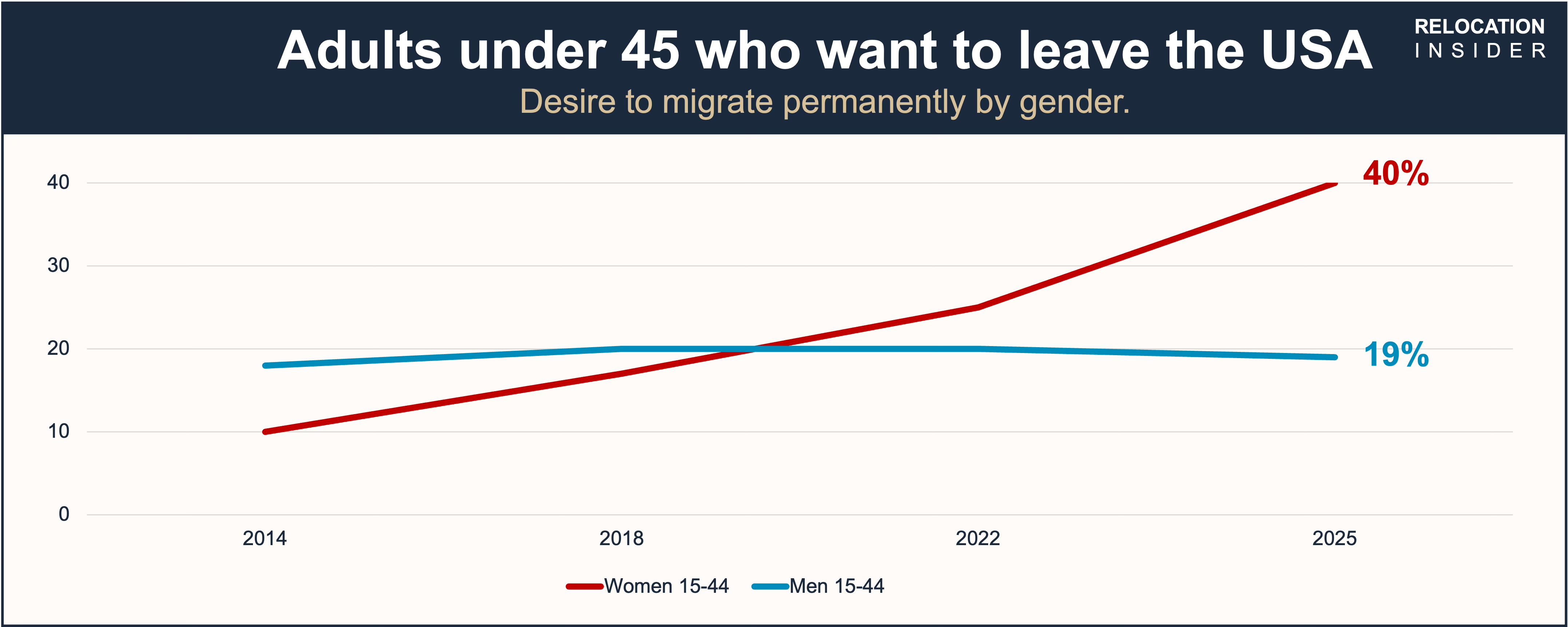
In late 2025, Gallup published a number that startled even veteran pollsters: 40% of American women aged 15-44 said they would move to another country permanently if they had the chance. That figure is four times higher than in 2014, when roughly one in ten young women said the same. Among young American men, the share stands at just 19%, and it has barely moved in a decade.
The resulting 21-point gender gap is the widest Gallup has ever recorded on this question, for any country, in the entire history of its World Poll. It is also uniquely American in one specific sense: across the other 38 OECD economies, young women’s desire to migrate has held steady at 20-30% for years. Around 2016, young American women crossed that band and kept climbing.
Two details suggest this is more than a mood.
Marriage no longer anchors women the way it used to:
41% of married and 45% of single young women now want to leave, the narrowest gap on record. And the sentiment cuts across racial groups.
What drives it, per Gallup, is a collapse in institutional trust:
Young women’s confidence in national institutions has fallen 17 points since 2015, the steepest drop of any cohort, with confidence in the judiciary alone falling from 55% to 32% in the years around the 2022 Dobbs ruling.
Europe: from wanting to leave, to actually leaving
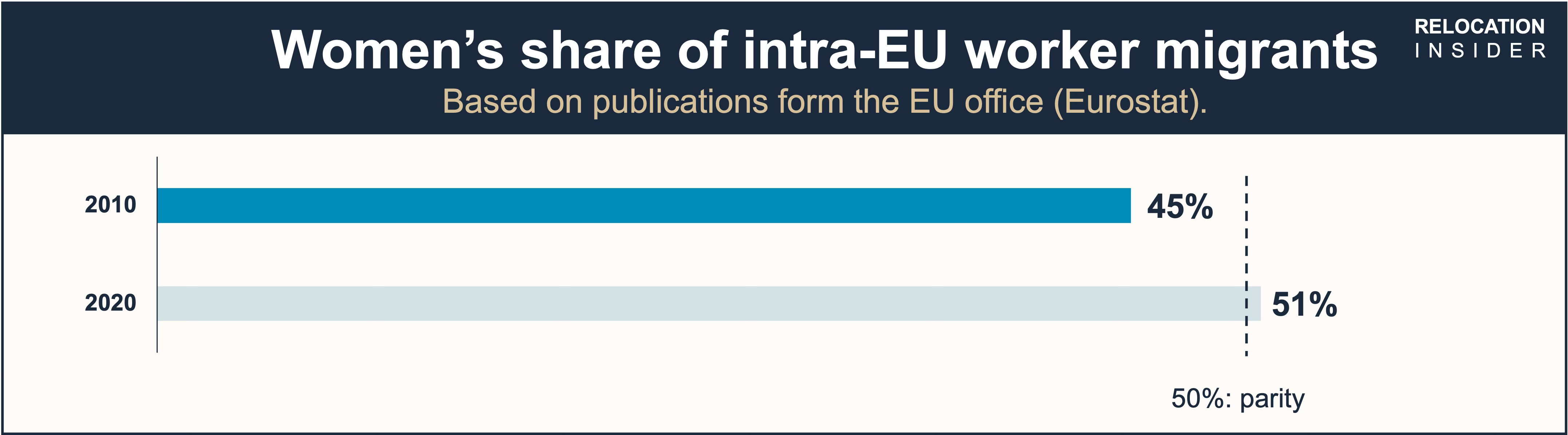
If America's story is about intent, Europe's is about movement. In 2010, men made up 55% of citizens migrating between EU countries for work, the classic pattern of male labor migration. By 2020, that had flipped: women were 51% of intra-EU worker migrants. Researchers now speak plainly of the "feminization of migration" in Western Europe, where female migrants have come to outnumber male migrants in many EU countries since 2018, after being far scarcer in the early 2000s.
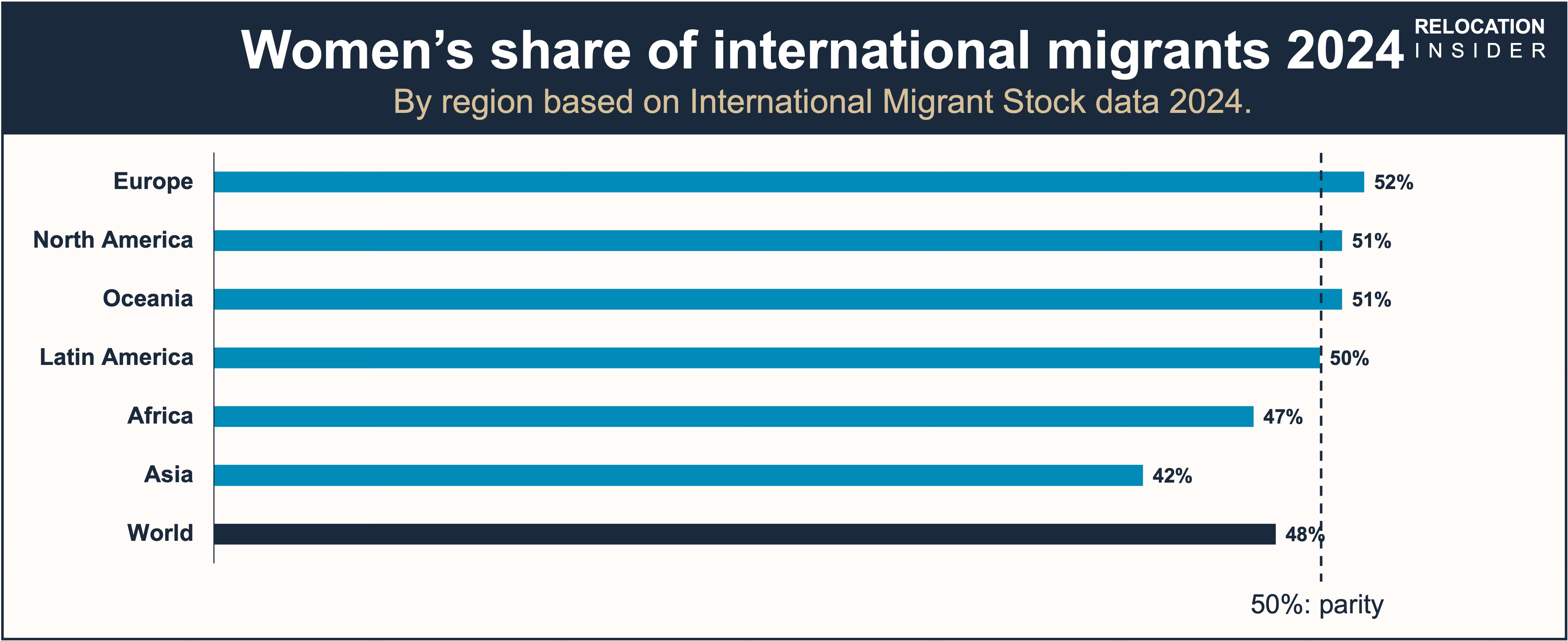
Europe is now the most female-skewed migration destination on the planet. Per UN DESA's 2024 migrant-stock estimates, women make up 52% of all migrants living in Europe, the highest share of any world region, against a global average of 48% and a low of 42% in Asia. Female migrants outnumber males in the major Western destinations: the United States, Canada, France, Spain and Italy, while the male-majority destinations are concentrated in the Gulf's construction economies.
Who is leaving European countries is just as telling. Among European origin countries, Ukraine and the Russian Federation have the highest shares of female emigrants, and Italy and Portugal are the only two whose emigrants are majority male. In other words, from nearly every European country, the person most likely to leave is a woman. Ukraine is the extreme case: women already accounted for 56.6% of the country’s long-term migrant workers before the full-scale invasion, and the war-driven exodus that followed, with fighting-age men barred from exit, pushed Ukraine into the world’s top five origin countries, its emigrant population growing 124% between 2020 and 2024. Most of those refugees are women and children, resettled largely within Europe, where 74% of all migrants born in Europe stay within the region.
The professional class tells the same story globally. A Population Council study of LinkedIn data found that the population of migrant professionals is majority-female in the United States, the United Kingdom, France, Australia, South Korea and Singapore, with women moving into finance, healthcare and real estate. Among Americans working remotely abroad, an InterNations survey found more than half are women. And a long-standing OECD finding hovers over all of it: emigration rates among the highly skilled are higher for women than for men from almost every country of origin.
Why women are the ones leaving
1. Politics and rights, on both continents
In the United States, the surge in exit dreams tracks the collapse of young women’s institutional trust described above; relocation firms reported traffic spikes from women researching visas and healthcare abroad immediately after the Dobbs decision. Europe has its own version: from nearly every European origin country the typical emigrant is now a woman, and the two most female-skewed emigrant populations, Ukraine’s and Russia’s, are shaped by war, conscription rules that keep men home, and the search for safety and rights elsewhere.
2. The work and wage ledger doesn’t balance at home
American women weigh a country with no federally mandated paid parental leave, employer-tied healthcare and thin vacation allowances; only 25% of US women tell Bankrate their version of the American dream is achievable, versus 33% of men. European women face a different ledger with the same conclusion: wide gender employment gaps in Italy, Spain, Romania, Hungary and Czechia push women across borders toward fairer labor markets, while in Moldova roughly a quarter of the economically active population already works abroad and countries like Albania, Bulgaria and Serbia keep watching their young people go.
3. Education has made mobility female
Women now out-graduate men across both continents, and degrees travel. Highly educated women are more likely than comparable men to land higher-paying jobs abroad, and the OECD finds skilled emigration rates are higher for women than men from almost every country of origin. The Population Council’s LinkedIn study confirms the result: majority-female professional migrant populations in the US, UK, France, Australia, South Korea and Singapore.
4. Aging Europe is actively hiring women
Demand pulls as hard as frustration pushes. The care, health and service sectors of aging Germany, Italy and Czechia recruit heavily in fields where the workforce is predominantly female, turning Europe’s demographic crunch into a standing job offer for women from Southern and Eastern Europe and beyond. It is a key reason women now make up 52% of Europe’s migrant stock.
5. Life abroad is visible, and looks attainable
Social media has turned other countries’ daily rhythms into content: the Danish workday that ends at four, the Portuguese cost of living, the French au pair year. Analysts note this visibility makes leaving feel accessible on both sides of the Atlantic. Motherhood barely changes the calculus: a Harris Poll found 44% of childless American women and 40% of mothers would consider moving; several mothers cite family-friendly policies abroad as the reason to go, not stay.
“Women increasingly lack faith in national institutions and picture their futures beyond America’s borders.” (Gallup, 2025)
Where they want to go
American women: the wish list
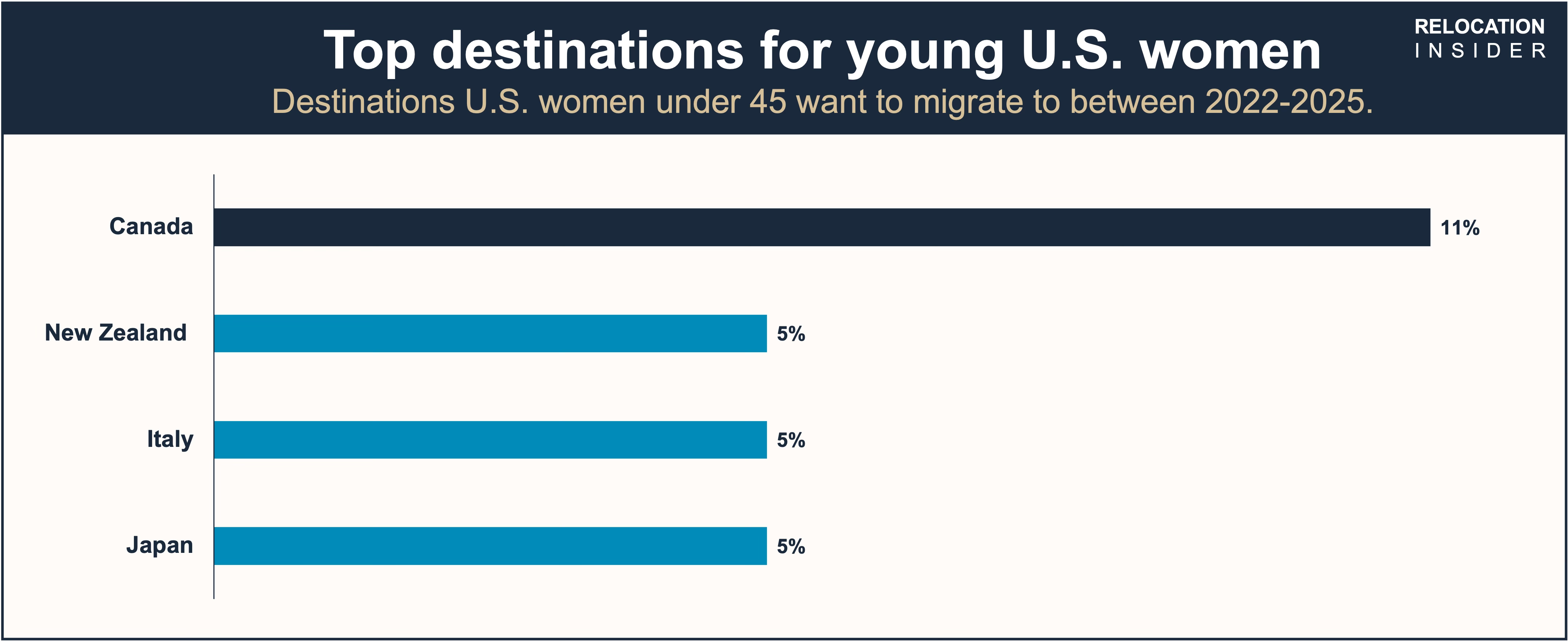
Among young American women, Canada is the runaway first choice (named by 11% since 2022), followed by New Zealand, Italy and Japan (5% each). Europe looms large as a “Plan B”: a 2026 Global Citizen Solutions report found emigration interest concentrating on European destinations, drawn by residency visas, healthcare and perceived stability, even as women already abroad caution that Europe is “a lot more nuanced” than the progressive haven of the imagination.
European women: shorter moves, real ones
European women mostly move within Europe: 74% of migrants born in Europe stay in the region. The classic routes run south to north and east to west, from Southern Europe toward Germany, Belgium and France, and from Ukraine, Romania and the Balkans toward Poland, Germany, Italy and Czechia, often into health and care work. Free movement makes the leap radically easier than the American version: an Italian nurse or a Spanish engineer needs no visa at all to start over in Berlin or Copenhagen, which is precisely why European intent converts into actual moves at rates America’s dreamers have yet to match.
What the trend means
For the countries being left
The arithmetic is unforgiving. The women most likely to go are educated and of working and reproductive age, so each departure removes not just a taxpayer but future births, care capacity and skills. Economists warn that in the U.S., fewer working women means a thinner base supporting Social Security and Medicaid just as the population ages; the OECD has long flagged the female tilt of the skilled “brain drain” as a distinct policy problem. For Southern and Eastern Europe the loss is already visible, not hypothetical: shrinking, aging populations in Italy, Bulgaria, Serbia and Moldova lose the very women who would have staffed their own care systems and raised the next generation, even as their departures ease labor shortages in Germany or Poland. One partial offset flows back: women remit a larger share of their earnings home, and more regularly, than male migrants do.
For destination countries
It is a windfall: Canada, Germany, Portugal and New Zealand are receiving self-selected, educated, working-age arrivals, precisely the migrants aging economies say they want. Research also suggests migration is often genuinely empowering for the women themselves, who gain earning power and autonomy abroad.
For politics and society
The departure gap is a symptom as much as a trend. Young American women now lean Democratic by 59% versus 39% of young men, and in Europe’s emigration belt the exit of educated young women skews hometown sex ratios and politics in ways demographers are only beginning to map. On both continents, a world where women plan to leave while men plan to stay deepens an already stark divide in dating, marriage and civic life.
Thinking of joining them? Start here!
First, the honest caveat: wanting to move is not moving. LinkedIn data suggests the population expressing migration intent is roughly five times larger than those who actually relocate. What separates the 40% who dream from the few who land is not courage. It’s homework. If this article reads less like news and more like a mirror, here is how the women who actually made it approached the move.
1. Pick the legal pathway before the country
The dream destination is irrelevant if you can’t stay. EU citizens hold the strongest card: free movement means no visa at all within the bloc. Everyone else maps eligibility first: work permits, digital-nomad and remote-work visas, student routes, ancestry citizenship (a real option for many Americans with European grandparents), or residency-by-savings programs like Portugal’s. Women who moved successfully describe starting from “what am I eligible for?” rather than “where do I want to live?”
2. Do a rehearsal trip, off-season
The mothers and professionals interviewed about their moves consistently made scouting trips first, testing groceries, transit, healthcare access and winter weather rather than vacation highlights. Social media shows the Danish 4 p.m. workday; it doesn’t show the November darkness or the residence-permit queue.
3. Price the whole ledger, not just rent
Lower cost of living often comes with lower local salaries, whether you’re moving Milan-to-Munich or Chicago-to-Lisbon. Americans should also budget for a detail many discover late: the U.S. taxes citizens on worldwide income, so plan for annual filings even after you leave. Europeans moving within the EU should check how pension years transfer and where their health coverage follows. These safety nets, the very things pulling women abroad, vary enormously even between neighboring countries.
4. Check that your credentials travel
The OECD data showing educated women thrive abroad comes with fine print: regulated professions such as nursing, teaching, law and therapy often require local recognition or licensing. Start that paperwork a year out, and research whether your industry hires internationals at your level in your target market.
5. Build your community before wheels-up
Women who report the smoothest landings connected early with expat networks, local Facebook and relocation groups, and, crucially, locals, not only fellow Americans. Loneliness, not bureaucracy, is the most commonly cited reason people move back.
6. Adjust the fantasy
As one American in France put it, Europe is “a lot more nuanced” than the progressive haven of the imagination. Politics shift there too, and the pay gap, housing crunches and childcare waitlists exist abroad in local flavors. The women who stay are the ones who traded a perfect destination for a workable one.
The data says the desire is real, historic and overwhelmingly female. Whether it becomes your story comes down to the unglamorous middle part: a visa category, a spreadsheet, a scouting trip and a two-year plan. Europe’s numbers prove the door opens, but it opens to the prepared.