

72 Countries Now Offer Digital Nomad Visas (Including One New Country in 2026)
The global race for remote talent is increasing as more countries open dedicated visa pathways for digital nomads in 2026


In 2020, a handful of forward-thinking countries like Estonia, Barbados, and Georgia launched programs to attract remote workers and see what happened. It worked. Other governments took note.
By 2023, roughly 50 countries had some version of a formal digital nomad program. By 2025, that number had crossed 70.
As of 2026, it stands at 72 countries.
This article gives you a reference overview of all 73 programs (the UAE has 2 programs in one country), organized by region, with the practical details you need to compare your options.
Whether you’re planning your first relocation or evaluating your next home base, this is the complete picture as it stands today.
What are digital nomad visas and who are they for?
Digital nomad visas let foreign nationals live in a country while working remotely for employers or clients based elsewhere. No local job offer. No employer sponsorship. You bring your existing income with you and the host country gives you a legal framework to stay.
The arrangement suits both sides. You get residency and usually a tax-efficient structure. The country gets a higher-spending resident who doesn’t compete with the local workforce, which is why nearly every program explicitly prohibits working for local companies or clients.
You’ll typically need to show consistent income through bank statements or employment contracts, hold valid health insurance, and meet a minimum monthly threshold that varies widely by country, from €800/month in Montenegro to $80,000/year in Thailand.
Not the right tool if you want to work locally, hire local staff, or land permanent residency without a separate application. For those goals, other visa categories apply.
List of digital nomad visas (2026)
Below is a detailed overview of the all digital nomad visas available in 2026, including income thresholds, permitted duration, tax treatment, and family eligibility:
One new digital nomad visa in 2026
🇳🇵 Nepal (launched early 2026)
Nepal is the newest entry on this list and arguably the most surprising.
The country introduced its digital nomad visa at the start of 2026 with a minimum income requirement of just $1,500 per month or $20,000 in savings as an alternative threshold. That makes it one of the cheapest formal entry points anywhere in Asia, comparable only to some of the most accessible Caribbean programs for sheer accessibility.
The appeal beyond the price is obvious. Nepal offers extraordinary natural environments, the Himalayas, national parks, trekking routes that are among the world’s finest, combined with a deeply spiritual and culturally rich daily life. Kathmandu and Pokhara, the two main hubs, both have growing digital infrastructure, coworking spaces, and a well-established community of long-term expats and independent travelers.
The cost of living is among the lowest of any country on this list. A comfortable lifestyle in Kathmandu. Good accommodation, restaurants, and transport. Runs well under $1,000 per month for most people. Internet speeds have improved considerably, and electricity reliability has increased with infrastructure investment.
This is not a program for everyone. Nepal is complex, logistically demanding in parts, and not a plug-and-play relocation in the way that Lisbon or Medellín might be. But for adventurous nomads who want an extraordinary base at a very low cost, it’s one of the most compelling new options of 2026.
Minimum income: $1,500/month (or $20,000 in savings)
Duration: 1 year
Family: Yes
Tax: Tax-free on foreign income
Cost of living: Very low
Relocation Insider: The most accessible formal nomad visa in Asia by income threshold, paired with one of the most remarkable physical and cultural environments on the planet.
Europe (27 programs)
Europe remains the largest and most structured region for digital nomad visas, offering everything from Portugal’s residency pathway to Georgia’s zero-bureaucracy year-long stay.
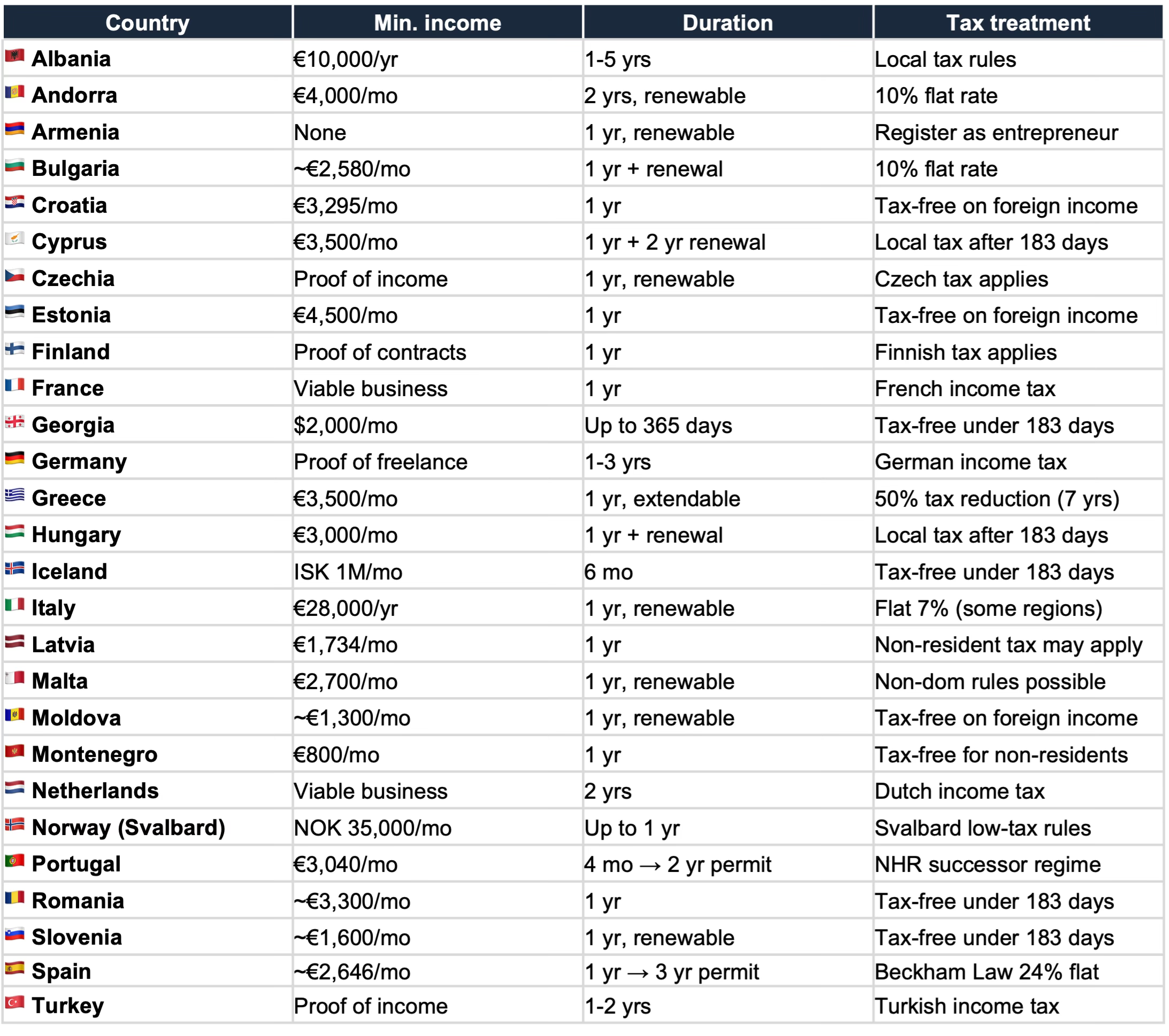
Relocation Insider picks in Europe: Portugal for the residency pathway. Spain for the Beckham Law tax treatment. Georgia for zero bureaucracy and a one-year visa-free stay. Montenegro for the lowest income threshold. Slovenia for the best value in an EU/Schengen country.
Americas & Caribbean (22 programs)
Latin America and the Caribbean offer the widest range of income thresholds, from Ecuador’s accessible $1,350/month to Montserrat’s $70,000/year. The region is also the most consistent for tax treatment: nearly every program exempts foreign-sourced income from local taxation entirely.
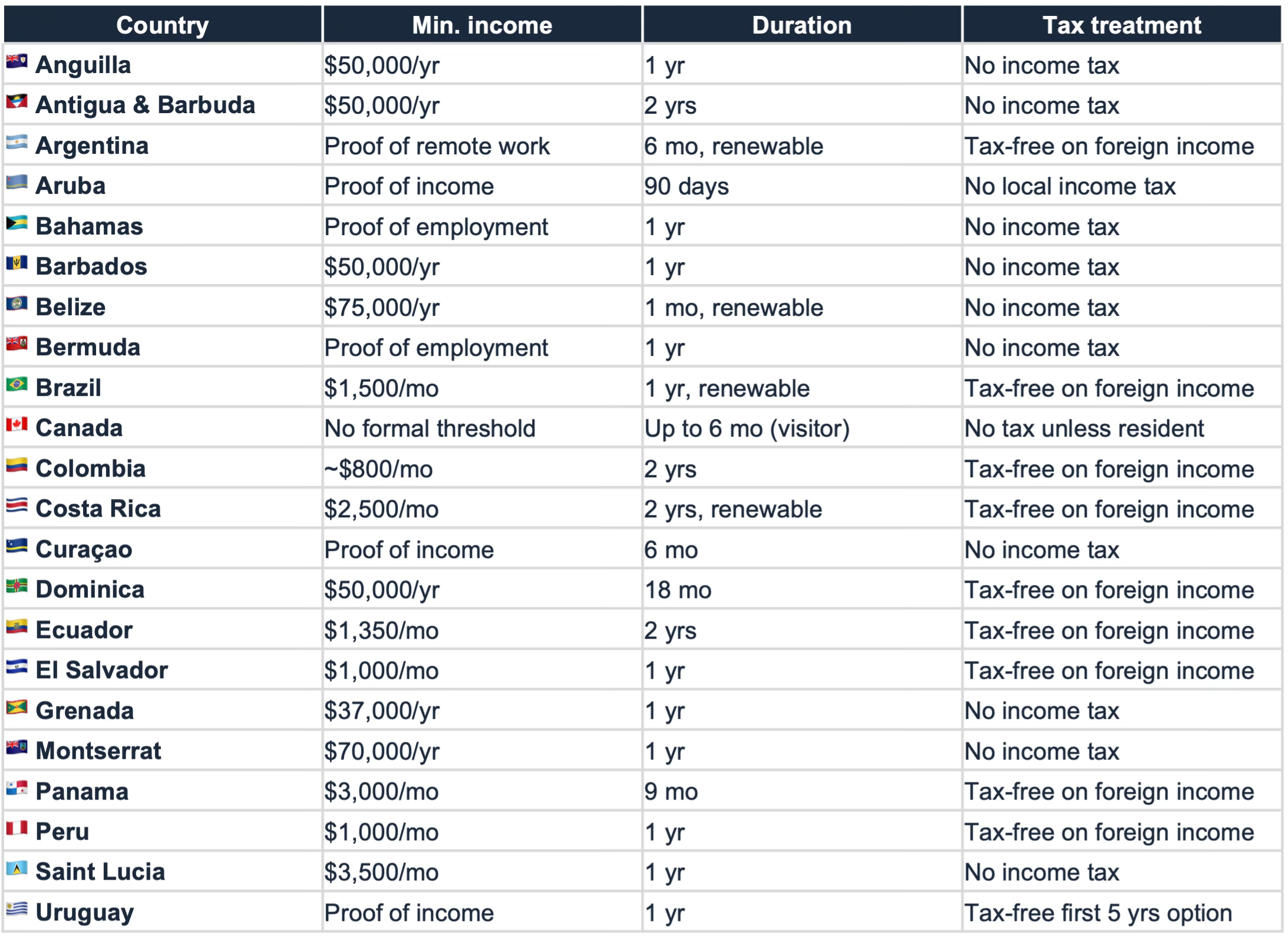
Relocation Insider picks in the Americas: Colombia for the two-year visa and improving infrastructure. Ecuador for the most accessible income threshold in the region. Barbados for established expat infrastructure. Brazil for South America’s most active nomad community.
Asia & Pacific (16 programs)
Asia’s programs vary more than any other region. From Japan’s six-month ceiling and $68,000 income bar to Nepal’s $1,500/month entry point. The range reflects how differently governments across the region are approaching the same challenge.
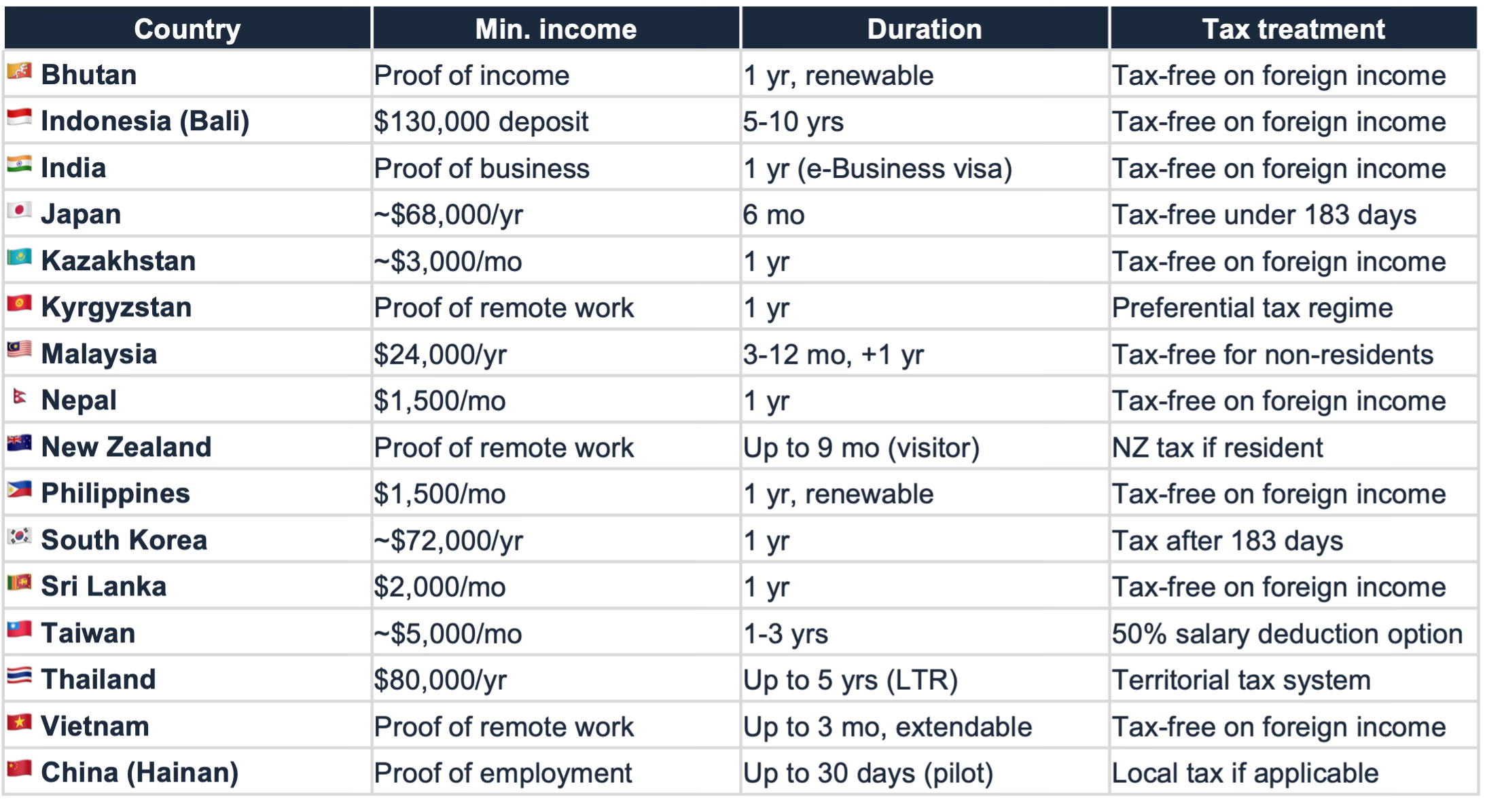
Relocation Insider picks in Asia: Malaysia for value and English-language ease. Philippines for the new mid-tier entry point. Taiwan for long-term residency potential. Nepal for the most accessible threshold in the region. Avoid Japan if you’re looking for a genuine base, six months is not enough.
Africa & Indian Ocean (6 programs)
Africa remains underserved in nomad visa coverage relative to its appeal, but the programs that do exist are genuinely compelling, particularly for nomads earning in hard currencies.
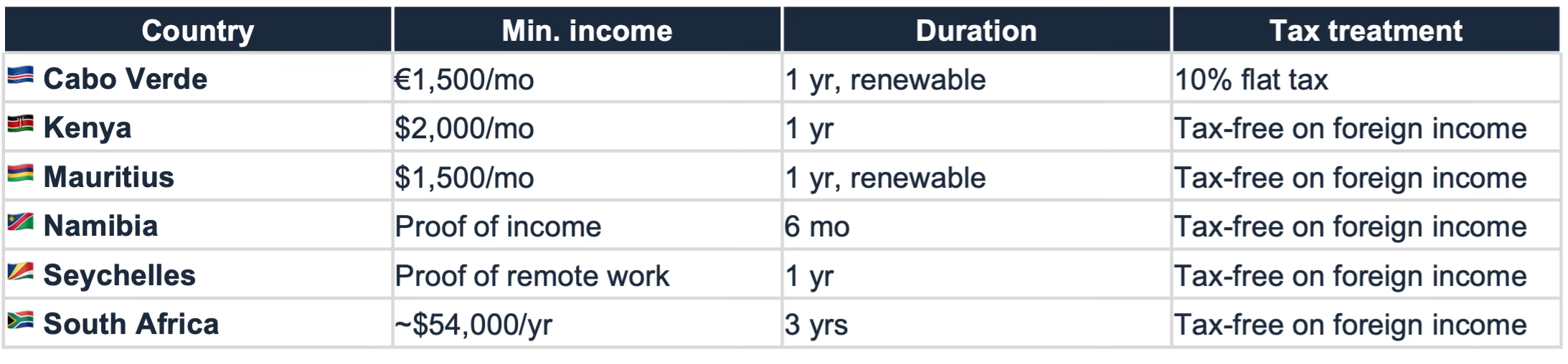
Relocation Insider picks in Africa: South Africa for the three-year duration and Cape Town’s exceptional lifestyle. Mauritius for Indian Ocean island living at a reasonable income threshold. Kenya for Nairobi’s rapidly growing tech ecosystem.
Middle East (2 programs)
The UAE operates two separate visa frameworks, Abu Dhabi and Dubai each run their own program. Both offer zero income tax and world-class infrastructure, with Dubai’s $5,000/month threshold among the highest of any program globally.

Relocation Insider picks in the Middle East: Dubai for high earners who want zero income tax, world-class infrastructure, and a genuinely cosmopolitan city. Abu Dhabi for a slightly lower threshold and a quieter, less saturated expat environment than Dubai.
How to choose the right relocation country
The number of options is now large enough that picking a country without a framework is genuinely overwhelming. A few principles that cut through the noise:
Start with duration, not location
A six-month visa (Japan, Iceland, Aruba) is a long vacation. A one-to-two-year permit with renewal rights is an actual relocation. Know which you’re planning before comparing countries.
Understand the tax picture before you apply
Most programs exempt foreign income from local taxation if you stay under 183 days but several (Spain’s Beckham Law, Bulgaria’s flat rate, Portugal’s IFICI regime) offer structured tax treatment for those who establish longer-term residency. For high earners, the tax math can be the biggest variable in the decision.
Match the income threshold to reality
There’s a significant difference between programs that are technically available to you and ones you’ll actually qualify for comfortably. Moldova at €1,300/month and Nepal at $1,500/month are accessible to early-stage freelancers. Estonia at €4,500/month and South Korea at ~$72,000/year are designed for established professionals.
Consider the pathway, not just the permit
If long-term residency or eventual citizenship is part of your plan, the landscape looks very different. Portugal, Spain, and several Latin American countries offer clear pathways. Japan, Croatia, and most Caribbean programs do not.
The global map of digital nomad visas is no longer in its early adopter phase. Seventy-five countries have run the numbers and decided that remote workers are worth competing for. The programs are diverse, improving, and, especially with the five new additions this year, increasingly accessible at multiple income levels.
The question is no longer whether legal long-term remote living is possible. It’s which of the 73 programs actually fits your life.
Great reference table. Worth expanding on your Brazil pick — the income test is friendly (US$1,500/mo or ~US$18k savings), but "South America's most active nomad community" undersells how regionally split it is. Floripa and Sao Paulo get the headlines, but the fastest-growing base is the Ceara coast in the Northeast: Fortaleza-area airports moved ~6.93M passengers last year (+9.2%), the Jericoacoara airport alone grew 21.5%, and Fraport runs that concession through 2047 — so a once-remote kite/wing region is getting direct European flights. Cost of living sits well under the Lisbon/Medellin tier with 300+ wind days a year, which is exactly why it's pulling the remote-work + watersports crowd. Tourism is already ~10.3% of state GDP. One caveat that fits your "pathway, not just permit" point: the nomad visa doesn't auto-convert to permanent residency, so plan that track separately. I mapped the wind/airport/cost data for that stretch here if useful: https://blog.terraventos.com/p/jericoacoara-property-guide-invest
Just about to start my first in Greece next month. That’s 71 to go!