

Weekly Relocation News: Japan Raises Visa Fees 400%, the UK Removes Visa Stickers, Europe Builds a Talent Platform (+ 3 More Updates)
Your weekly briefing on visas, residency programs, tax changes, and what's shifting for people living abroad or planning their next move

Each week Relocation Insider tracks global relocation news covering visa, residency, and tax changes for people living abroad or planning their next move.
Weekly Relocation News Overview:

Country updates (#6 News)
#1: South Korea updated its digital nomad visa
South Korea announced its Workation visa (F-1-D) as a permanent program on June 30, 2026, after two years as a pilot program.
The visa stay limit extends from 2 to 3 years. Family members can now come with you and the income threshold has dropped.
The update is coming after the pilot phase with a threshold of $74K per year regardless of age attracted only 398 people as of May 2026 (after 2 years of testing the program).
Under the new visa rules, applicants aged 18-34 living outside Seoul only need to show an income of ~$37K per year. Those 35+ or based in Seoul still need the old 2x GNI threshold of ~$74K per year.
Who is affected:
Remote employees earning $37K+ looking for an East Asia base with dependents.
Self-employed and freelancers are still not eligible (must be employed by a foreign company).
#2 The U.S. changed student & exchange visa stays
On July 16, the United States Department of Homeland Security (DHS) announced a change of the “duration of status” for F (student), J (exchange visitor), and I (foreign media) visa holders.
Instead of staying as long as their program runs, holders now get fixed admission periods:
4 years for students and exchange visitors
240 days for journalists
90 days for Chinese nationals on media visas
These visa holders have now a clear end date on their admission and missing it doesn’t just create paperwork. It can derail a degree, void a research position, or trigger a bar on re-entry.
Who is affected:
International students & J-1 exchange visitors must now manage admission deadlines, not just program end dates.
Foreign journalists & media professionals: 240-day cap is tight for long assignments; Chinese nationals face a 90-day ceiling.
Anyone mid-program: check your I-94 admission record to understand where you stand under the new framework.
Work visa holders (H-1B, O-1, etc.) are not affected by this rule change.
#3 The UK went digital and removed the visa sticker
As of July 1, 2026, UK Visas and Immigration (UKVI) stopped using physical visa stickers to new applicants. Applicants now receive an eVisa and must manage their immigration permission through an online UKVI account.
The new change has caught people out, especially those applying from countries with weak internet access or who travel through border crossings that still expect a physical document.
Your immigration status is now displayed in a government portal, which means your UKVI account login is as important as your passport.
Who is affected:
Students, workers, and families applying for UK visas: no sticker will be issued; get your eVisa account set up before you travel.
Frequent travelers: border officers check your status digitally (make sure your eVisa is active and linked correctly before every trip).
Existing visa holders with valid stickers: sticker remains valid until it expires.
British citizens and settled status holders are not affected by this rule change.
#4 Europe is building a job platform for global talent
The European Commission is building a job platform, expected to be fully operational by end of 2027. The goal is to establish a single EU-wide digital marketplace connecting non-EU jobseekers with European employers.
Right now, a skilled worker from outside the EU who wants to work in, say, Germany and then move to the Netherlands has to navigate two entirely separate immigration systems.
The EU Talent Pool, will change that by creating a single profile that participating member states can access. Think of it as LinkedIn for EU work visas, built by Brussels.
Who is affected:
Non-EU professionals in shortage fields (healthcare, engineering, tech, construction).
Employers across EU member states get easier access to pre-screened international candidates without country-by-country recruitment processes.
For EU citizens the new job platform is not relevant as the platform targets third-country nationals only.
#5 Taiwan launched a 2-year digital nomad visa
Taiwan expanded its digital nomad visa to cover stays of up to 2 years. It is structured as an initial 6-month stay and renewable three more times in 6-month increments.
The income thresholds are low by regional standards:
$20K/year for applicants aged 20-29
$40K/year for those 30 and above
For context, that’s roughly half what South Korea requires for the same age brackets and a fraction of Thailand’s LTR visa bar. With the new launch, Taiwan wants to target young remote workers.
Who is affected:
Young remote workers (20-29) earning $20K or more: one of the lowest income bars on any digital nomad visa globally.
Anyone wanting a safe, affordable, well-connected East Asia base that isn’t Seoul or Tokyo.
Freelancers or self-employed workers should verify carefully before applying. Requirements around employer type are still being confirmed across sources.
#6 Japan raised its visa fees 400%
From July 1, 2026, Japan increased visa fees for over 100 nationalities for the first time in almost 50 years (first time since 1978):
Single-entry went from ¥3,000 (~$18) to ¥15,000 (~$93)
Multiple-entry from ¥6,000 (~$37) to ¥30,000 (~$186)
Permanent residency application fee increased to ¥200,000 (~$1,250) and comes later in 2026
Departure tax tripled from ¥1,000 to ¥3,000 for all travelers
Who is affected:
Indian, Chinese, Vietnamese, and South Asian passport holders: budget for the new costs.
Long-term Japan plans: the PR fee jumping to ¥200,000 is a 20x increase (factor that into your timeline).
Frequent nomads using Japan as a stopover: JESTA in 2028 will change the cost model even for currently exempt nationalities.
Western passport holders are not affected for now but Japan is developing JESTA, a fee-based pre-entry system similar to the US ESTA, planned for 2028.
Country Watch List
Covers smaller global updates that don’t need a full story but are worth knowing before they affect your plans.
China: Visa-free entry for citizens of 40+ countries (EU, Australia, NZ, Gulf states) extended through December 31, 2026. US, Canada, and UK still require a visa.
Belgium: New administrative fee of €180 for Single Permit applications for non-EEA nationals hiring in the Flemish Region, effective September 1, 2026.
Paraguay: Updated economic solvency requirements for permanent residence applications as of July 8, 2026. Worth checking if Paraguay is on your radar as a low-tax residency option.
Australia: Fees increased for certain visa types and citizenship applications effective July 1, 2026.
Relocation Data of The Week
One surprising number/graphic each week pulled from immigration data, visa programs, or cost-of-living reports that puts global relocation trends in perspective.
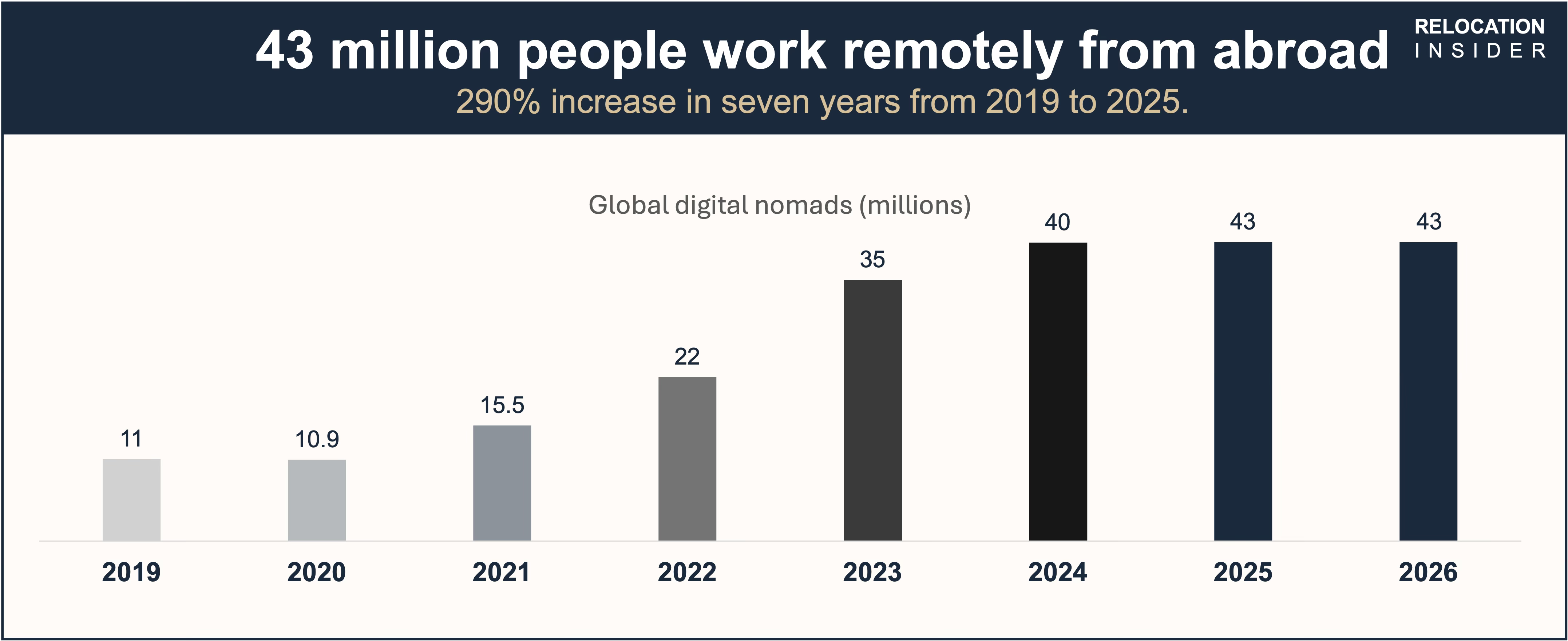
The digital nomad population has grown from 11 million in 2019 to 43 million in 2026, a 290% increase in seven years!
The pandemic did not create this shift, it accelerated it. What started as a temporary arrangement became a permanent career choice for millions, reshaping where they live and how governments compete for them.
The global race for remote talent is increasing and that’s why 72 countries now offer digital nomad visas (including one new country in 2026).
Visa Rejection Watch
Rejections, delays, consulates behaviours, and informal requirements that visa applicants experienced but nobody publishes.
🇪🇸 Spain (Digital Nomad Visa): US applicants are reporting increasing rejection rates at Barcelona and Madrid consulates, with the most common reason being insufficient proof of income stability, even when the stated monthly threshold is met. Consulates are asking for 12 months of bank statements, not the 3 months listed officially.
🇵🇹 Portugal (D8 Visa): Processing times have stretched to 5-6 months for non-EU applicants. Applicants report no communication for more than 90 days after submission. Do not book flights or accommodation until the visa is physically in hand.
Final Words Before You Leave
If you think this article was useful, feel free to forward it to friends, family members, colleagues, etc. thinking about moving abroad.
It only takes 10 seconds! :)
That’s how this newsletter grows and it costs you nothing.
Do you have a question about a visa, specific countries, or a decision you’re sitting on? Leave your comment below or share a message with me.